

Soft-palate support
Solea Sleep
Low-dose laser energy is used to tighten collagen fibers in the soft palate. The goal is to reduce tissue vibration and airway looseness that can contribute to snoring.
You stop breathing, wake up exhausted, and the CPAP is still sitting in a drawer.
Sleep apnea oral appliance NYC care at Centre Dental is built for patients who snore, wake tired, or cannot tolerate CPAP after a sleep study. Dr. John Shi may combine Solea Sleep soft-palate laser therapy with a DMAD oral appliance, using Primescan and iTero Lumina records to plan the fit, adjustments, and follow-up.
CPAP intolerant?No shame. We look at what you can actually wear.
Combination care.Solea Sleep and DMAD are planned around the diagnosis.
Digital fit.Primescan and iTero Lumina help us plan comfort before fabrication.
The actual treatment path
Centre Dental now frames the visit around a combined airway approach: diagnosis first, Solea Sleep when soft-palate tissue is part of the problem, and a DMAD oral appliance when jaw-position support is appropriate.
2
treatment tools: Solea Sleep plus DMAD when indicated
2
scanner systems: Primescan and iTero Lumina
Bring
sleep-study report, CPAP notes, medical insurance
Expect
scan, bite record, fitting, and small adjustments
Decide by
comfort, nightly use, symptoms, and follow-up testing
01
We start with the diagnosis, apnea severity, physician direction, and your real CPAP history. No sleep study yet? The first step is referral or coordination, not making a device.
02
Dr. Shi checks teeth, gums, bite stability, jaw joints, airway signs, and whether your mouth can safely support a mandibular advancement appliance.
03
Centre Dental uses Primescan and iTero Lumina scanners to capture the upper arch, lower arch, bite, and airway-relevant dental records before a custom appliance is ordered.
04
Dr. Shi decides whether the plan should combine Solea Sleep soft-palate laser treatment with a DMAD appliance, based on diagnosis, anatomy, comfort, and physician direction.
05
At delivery, retention, pressure spots, bite feel, and home instructions are checked chair-side so the appliance has a real chance of staying in all night.
06
Small forward adjustments are made over several weeks. The goal is symptom improvement without creating jaw pain or tooth movement.
07
When apnea is documented, we coordinate objective re-testing while you wear the device. Quieter sleep is good; measured airway improvement is the proof.
08
Your bite, appliance fit, jaw comfort, and symptoms are checked over time because oral-appliance therapy is ongoing medical care, not a one-time gadget.
Combination sleep therapy
Dr. Shi's direction is to combine Solea Sleep and a DMAD oral appliance when the case supports it. That lets the page speak to the patient who wants relief from snoring and CPAP frustration, while staying honest about diagnosis and follow-up.
Soft-palate support
Low-dose laser energy is used to tighten collagen fibers in the soft palate. The goal is to reduce tissue vibration and airway looseness that can contribute to snoring.
Jaw-position support
A dentist-managed mandibular advancement device gently holds the lower jaw forward during sleep, helping keep the airway behind the tongue more open.
Digital records
High-detail intraoral scans replace guesswork. They help Dr. Shi plan fit, bite position, appliance comfort, and the follow-up adjustments patients actually feel.
Digital appliance workflow
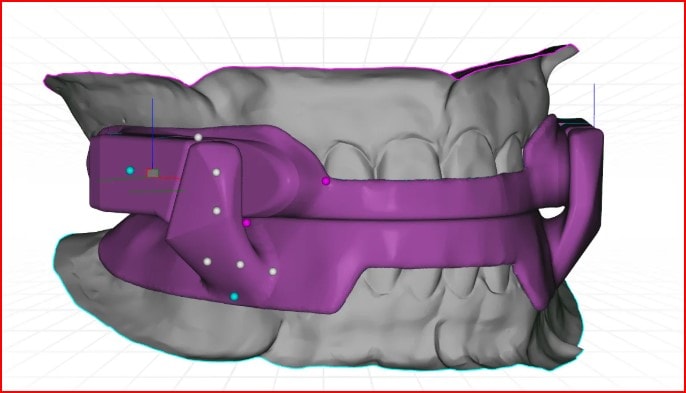
Panthera's D-SAD workflow shows why this is not a drugstore tray. At Centre Dental, Primescan and iTero Lumina records support the same core idea: clean digital data first, appliance design second, then careful fit checks and small titration changes after the patient starts wearing it at night.
Sleep study, airway symptoms, oral exam, and scan or impression decide whether appliance therapy is appropriate.
The lab builds a device around the recorded jaw position, not a generic mold.
Dr. Shi checks comfort, retention, jaw response, and symptom change before follow-up sleep testing when indicated.

02
When a traditional impression is the better route, the goal is the same: a clean record that lets the appliance fit the patient instead of fighting the patient.

03
The appliance design allows measured changes, which matters because mandibular advancement should be tuned gradually around comfort and airway response.

04
Rod changes support titration: small, deliberate jaw-position changes after the patient starts wearing the device at night.

05
Fit refinements can be made chair-side so pressure spots and retention issues are handled before the patient gives up on the device.

06
Material can be reduced in targeted spots when comfort needs correction, while preserving the appliance function Dr. Shi is monitoring.
Most people who come to us are not thinking about apnea-hypopnea scores and titration protocols. They are thinking about the elbow in the ribs at 3 a.m., the CPAP mask gathering dust in a drawer, and the fog that never lifts no matter how many hours they were in bed. If that is you, this page is built for the decision you are making now: what can actually replace or supplement CPAP, what a dentist can and cannot do, what proof is needed, and what happens before you say yes.
The mask, the hose, the pressure, the dry mouth — you tried, honestly, and it is still in the closet. That does not mean you are out of options.
Eight hours in bed and still foggy, irritable, or nodding off at your desk. Fragmented sleep does not feel like sleep.
The snoring, the gasping, the moment they watch you stop breathing and wait for you to start again — it is their sleep problem too.
Decision path
Confirm diagnosis
Sleep study and physician direction come before any device.
Check candidacy
Teeth, gums, bite, TMJ comfort, and airway signs decide whether appliance therapy is safe.
Treat + verify
The appliance is fitted, adjusted, then checked against symptoms and follow-up testing.
A mandibular advancement device is a custom-fitted appliance that positions your lower jaw slightly forward during sleep, opening the airway behind the tongue so it does not collapse and block your breathing. It is silent, travels in a pocket, needs no power or hose, and it only helps if you keep wearing it. For primary snoring, physician-diagnosed mild-to-moderate obstructive sleep apnea, and patients who genuinely cannot tolerate CPAP, oral appliance therapy is a recognized option that we deliver, adjust, and verify against a real sleep test when apnea is documented.
Schedule a sleep appliance consultationUnderstand it fully
Obstructive sleep apnea (OSA) is the repeated collapse of the upper airway during sleep. As the muscles of the pharynx relax, the soft palate, uvula, and the base of the tongue fall back and block airflow — sometimes partially (a hypopnea), sometimes completely (an apnea). Each event drops your blood-oxygen level and jolts your brain toward waking to reopen the airway, often without you ever remembering it. Snoring is the sound of that tissue vibrating as air forces past it; it's the audible warning sign, not the disease itself. The severity of OSA is measured by the apnea-hypopnea index (AHI) — the number of these events per hour of sleep — which is why a diagnosis has to come from a sleep study, not a guess. We treat the airway, not just the noise, and we do it alongside your sleep physician through the process we call the Centre Method.
Oral appliance therapy is recognized by the American Academy of Sleep Medicine as a first-line treatment for primary snoring and mild-to-moderate OSA, and as a second-line option for severe OSA in patients who cannot tolerate continuous positive airway pressure (CPAP). The honest framing matters: CPAP is more efficacious at lowering the AHI on average, especially in severe disease. An oral appliance is the right answer when your OSA is mild-to-moderate, when you snore without documented apnea, or when CPAP has genuinely failed despite real attempts to acclimate to it. It is not a replacement for CPAP in severe apnea that CPAP is successfully controlling. And it is never fitted for undiagnosed snoring treated as if it were apnea — a formal sleep study and a physician diagnosis always come first. If your evaluation points toward in-office sedation needs rather than sleep-disordered breathing, that's a different service entirely — see sleep dentistry.
By the time someone searches for a sleep apnea dentist in Manhattan, they have usually seen the main options: CPAP, an over-the-counter snoring mouthpiece, surgery, weight loss advice, positional therapy, or a custom dental sleep appliance. CPAP is often the most powerful at reducing breathing events when it is worn, but many patients cannot tolerate the mask, pressure, travel burden, or nightly setup. Drugstore mouth guards may reduce noise for some snorers, but they are not physician-prescribed medical devices, do not hold a stable therapeutic jaw position, and should not be used to self-treat suspected apnea. Surgery can be appropriate for selected airway anatomy, but it is not the first practical step for most mild-to-moderate cases. A custom oral appliance sits in the middle: medical diagnosis first, dentist-fabricated device second, gradual adjustment third, then objective verification when apnea is present.
There is a paradox at the heart of sleep-apnea treatment: the most effective device on paper is not always the one that helps you most in real life, because treatment only works on nights you use it. In a randomized crossover trial published in the American Journal of Respiratory and Critical Care Medicine, CPAP reduced the AHI further than a mandibular advancement device (to 4.5 versus 11.1 events per hour), yet patients wore the oral appliance more — a mean of 6.5 hours per night versus 5.2 on CPAP — and important health outcomes after one month were similar between the two. That is the practical case for oral appliance therapy: an airway opening you use all night can compete with a stronger treatment you abandon at 2 a.m. It is also why we do not oversell it — severity, diagnosis, and nightly use decide whether it makes sense.
For the right case, Dr. Shi may discuss a Panthera D-SAD style appliance rather than a generic snoring tray. Panthera Dental describes its D-SAD appliances as digitally printed medical-grade nylon devices for snoring and obstructive sleep apnea, with low-profile designs, no metal parts in several models, and titration systems that allow small forward adjustments. Those details matter to a patient because bulk, comfort, retention, and adjustability decide whether the appliance stays in your mouth all night. The exact device is still chosen clinically — based on your dentition, bite, TMJ status, sleep-study diagnosis, and physician direction — but the goal is clear: a custom appliance thin enough to tolerate, strong enough to last, and adjustable enough to test rather than guess.
**For a limited time, Centre Dental is offering every DMAD patient complimentary Solea Sleep therapy ($845 value).** Solea Sleep is a non-surgical laser treatment for snoring, delivered with the same Solea CO2 laser we use for needle-free dentistry. The laser gently warms the deeper layers of the soft palate, which tightens and stiffens the collagen there. A firmer palate is less likely to vibrate and sag into your airway at night. Treatment takes about 15 minutes, uses a topical numbing spray instead of needles, and needs no downtime. ### Why the two work better together A DMAD (mandibular advancement device) and Solea Sleep work on different parts of the airway. The DMAD holds your lower jaw slightly forward, which draws the base of the tongue away from the back of the throat. Solea Sleep firms up the soft palate higher up, where much of the vibration behind snoring begins. Treating both areas addresses more of the airway than either treatment alone — which is why Dr. Shi pairs them. Solea Sleep treats snoring. It does not replace a sleep study or a diagnosis of sleep apnea, and Dr. Shi will confirm whether it suits your case at your consultation.
Your next step
Wondering if snoring & sleep apnea is right for you?
A free consultation includes an exam and a written plan — no pressure, no upsell.
Everything starts with digital intraoral scans of your upper and lower arches — no gag-inducing impression trays and no goopy putty. A precise bite registration captures the protruded jaw position we are testing. The lab then fabricates a custom mandibular advancement device that fits your teeth and connects in a way that holds the lower jaw forward while still allowing controlled movement. Because it is built from a scan of your own dentition rather than a stock boil-and-bite tray, it is thinner, retains a stable position all night, and is comfortable enough to wear consistently — which, as the adherence data shows, is the point.
A mandibular advancement device is not a one-and-done delivery. After you receive it, we titrate — making small, incremental forward adjustments, typically at about one-week intervals — until your snoring resolves and your morning symptoms clearly improve. Advance too little and the airway stays partly obstructed; advance too far, too fast, and you invite jaw soreness without added benefit. Most patients reach their therapeutic position within roughly four to six weeks. This slow, measured approach is deliberate: we're finding the smallest amount of advancement that fully opens your airway, because less protrusion means fewer long-term effects on your bite and better comfort over the years you'll wear it.
Feeling better is necessary but not sufficient in obstructive sleep apnea. Once your appliance is titrated, we coordinate with your sleep physician for a follow-up sleep test — a home sleep apnea test or an in-lab study — performed while you are wearing the device. The objective is a documented reduction in your apnea-hypopnea index, oxygen desaturation events, and arousals, not just a quieter bedroom. Without that measurement, we would be guessing at whether your apnea is controlled, and untreated apnea carries real consequences. Patients with primary snoring and no documented apnea are reassessed differently — by symptom and bed-partner report at the four-week and three-month marks — because there is no apnea index to re-measure. This verify-or-it-does-not-count standard is why we treat the appliance as medicine, not a gadget.
A BOFU patient does not need vague reassurance; they need to know what determines approval, cost, and next steps. Bring your sleep-study report, physician diagnosis, CPAP history if you have one, medical insurance card, dental insurance card, medication list, and any prior appliance or night guard. Oral appliance therapy is usually handled through medical insurance rather than routine dental benefits, and documentation often matters as much as the device itself. Centre Dental reviews your records, checks whether the clinical path fits, explains the appliance process, and provides a written estimate before treatment. If you have not completed a sleep study, the first step is referral or coordination for diagnosis — not making a device and hoping it solves the right problem.
In the first weeks, expect a short adjustment period: morning jaw soreness, slight tooth tenderness, and extra salivation are common and usually settle within about two weeks of consistent use. The long-term consideration is genuine and we won't soft-pedal it — holding the jaw forward night after night can gradually move teeth and shift your bite. Controlled research measuring dental casts before and after treatment has documented small but real reductions in overbite and overjet over a two-year span, and cephalometric studies of patients wearing appliances for years show these tooth-position changes tend to be progressive over time. That's exactly why we monitor your occlusion at every six-month dental visit and act early: if your bite starts to shift, options include a morning repositioner to reset the jaw, reducing the advancement, or re-evaluating the therapy. These risks are real — and they're weighed against the cardiovascular and cognitive toll of untreated apnea, which is also real. If you also grind your teeth, a related but distinct appliance may be part of the picture; see night guard therapy for bruxism.
Untreated obstructive sleep apnea isn't merely a nuisance for your partner. It's an independent risk factor associated with hypertension, coronary artery disease, stroke, and increased mortality — the downstream result of nightly oxygen dips, surges in sympathetic nervous-system activity, inflammation, and endothelial stress. Cohort data show the mortality risk rises with apnea severity. That's the frame we bring to every consultation: an oral appliance is a comfortable, wearable device, but the reason we insist on a real diagnosis, careful titration, and objective re-testing is that we're managing a medical condition with a dental tool. Getting it right — and proving it's right — is what protects the health outcomes that actually matter. Routine bite and airway monitoring continues as part of your ongoing preventive dentistry visits.
What patients say
My wisdom teeth have been bothering me for the past few weeks so I was tryna get an appointment as soon as possible. I called in centre dental on Thursday, got an appointment on Saturday. Dr Shi is so professional, the e…
The cleaning in this place was so pleasant with 0 to no pain. The people helping me out during this hard journey helped calm me down and helped eased all my worries.
Great experience—friendly staff, a clean office, and a dentist who made me feel comfortable throughout the entire visit.
Not sure if an appliance can replace CPAP for you?
That is exactly what the consultation is for. Dr. Shi reviews your sleep-study diagnosis, CPAP history, bite, jaw comfort, and insurance path, then tells you whether an oral appliance is a real option or whether another medical route is safer.
Thinking about it
Yes, if there's any suspicion of sleep apnea — which is most patients with a snoring complaint. A home or in-lab sleep study plus a physician diagnosis establishes whether you have primary snoring, mild-to-moderate OSA, or severe OSA, and each has a different first-line treatment. We won't fabricate an oral appliance for undiagnosed snoring treated as if it were apnea; that skips the step that tells us whether your airway is actually the problem and how severe it is.
CPAP uses a mask and a pump to splint your airway open with a steady stream of pressurized air. An oral appliance is a small custom mouthpiece that holds your lower jaw forward so the airway behind your tongue doesn't collapse — no mask, no hose, no power, no noise. On average CPAP lowers the apnea-hypopnea index more, but many people can't tolerate it and stop using it. Because the device you actually wear every night is the one that helps, an oral appliance is often the better real-world choice for mild-to-moderate OSA and for CPAP-intolerant patients. We'll help you match the tool to your disease severity and what you'll realistically use.
It can be, especially for physician-diagnosed mild-to-moderate obstructive sleep apnea, primary snoring, or patients who cannot tolerate CPAP after a real attempt. It is not a universal CPAP replacement. If severe apnea is well-controlled with CPAP and you can wear it, CPAP often remains the stronger therapy. If CPAP is abandoned because of pressure intolerance, mask leaks, claustrophobia, travel, noise, or dry mouth, a custom oral appliance may be the practical next option. The decision starts with your sleep-study severity and physician direction, then Dr. Shi evaluates whether your teeth, gums, bite, and jaw joints can support an appliance safely.
A drugstore mouth guard may look similar in a photo, but it is not the same treatment. Over-the-counter trays are not made from your digital scan, do not document a therapeutic jaw position, do not include medical diagnosis, and usually are not titrated against symptoms or follow-up testing. They can also create jaw soreness or tooth movement if the fit is unstable. If your issue is simple primary snoring, Dr. Shi can discuss whether a custom dental appliance makes sense. If there is any chance of sleep apnea, self-treating with a boil-and-bite tray can quiet the warning sign while the airway problem remains.
Dr. Shi can discuss Panthera Dental D-SAD style appliance options when the case calls for a custom mandibular advancement device. Panthera describes its D-SAD appliances as digitally printed medical-grade nylon devices for snoring and obstructive sleep apnea, with low-profile designs and titration systems for small forward adjustments. The brand is not the starting point, though. The starting point is your sleep-study diagnosis, CPAP history, bite, gum health, TMJ comfort, and whether your physician agrees oral appliance therapy is appropriate. If the clinical picture fits, Panthera may be one of the appliance paths reviewed with you.
A custom mandibular advancement device is priced as a treatment package, not a shelf product. The fee depends on the diagnosis review, appliance type, bite record, lab fabrication, titration visits, and follow-up needs. Over-the-counter boil-and-bite devices are cheaper because they skip the medical and dental steps that make treatment safe: diagnosis, custom fit, titration, and verification. Because sleep apnea is a medical condition, coverage often runs through medical rather than dental benefits. You leave the consultation with a written estimate for your case, and we walk through your insurance and financing options before treatment starts.
Medical insurance — not dental — is usually the relevant coverage, and many plans do cover oral appliances for diagnosed OSA, particularly when CPAP has failed or been declined. Coverage generally requires the sleep study, physician documentation, and specific medical billing codes. Centre Dental provides all the required documentation, though reimbursement varies significantly by plan. We'll help you understand what your specific policy is likely to contribute before you commit — see insurance.
It can, and we tell you that plainly. Holding the jaw forward each night can gradually shift tooth position and reduce overbite and overjet over years of use — controlled studies measuring dental models before and after treatment have documented small but real changes, and these tend to be progressive. That's why we titrate to the minimum effective advancement and check your occlusion at every six-month visit. If a shift begins, we have answers: a morning repositioner appliance to reset the bite, reducing the advancement, or re-evaluating therapy. The risk is real and is weighed candidly against the consequences of leaving apnea untreated.
Delivery is just the start. Over roughly four to six weeks we make small weekly forward adjustments — titration — until your snoring resolves and your morning symptoms improve. Then, if you have documented apnea, we coordinate a follow-up sleep test while you wear the device to confirm your apnea-hypopnea index has actually dropped. So plan on about six to eight weeks from delivery to a fully titrated, verified result, and lifetime monitoring after that at your regular dental visits.
Most patients with primary snoring see a substantial reduction or complete elimination of snoring once the appliance is properly titrated, usually confirmed by a bed-partner report at around four weeks. One caution we always raise: snoring isn't automatically harmless. Because loud snoring can be the audible sign of underlying apnea, we recommend a sleep study to rule out OSA before treating snoring as a purely cosmetic or social issue — quieting the sound without checking the airway can mask a medical problem.
Bring your sleep-study report, physician diagnosis, CPAP prescription or CPAP history if you have one, medical insurance card, dental insurance card, medication list, and any night guard or old snoring appliance you have tried. If your partner has noticed pauses in breathing, gasping, or loud irregular snoring, write that down too. Those details help Dr. Shi decide whether the path is appliance consultation, physician coordination, or sleep-study referral first. A good visit should end with a clear next step: records needed, candidacy, estimated cost, insurance path, and what has to be verified before the appliance is considered successful.
There's documented overlap between teeth grinding (bruxism) and obstructive sleep apnea; a meaningful share of patients have both. If you grind, snore, and wake unrefreshed, we'll recommend a sleep study to evaluate for OSA rather than treating the grinding in isolation. The devices are different — a night guard protects teeth from grinding forces, while a mandibular advancement device opens the airway — and treating the apnea sometimes reduces the grinding. Sorting out which problem is driving which is exactly what the evaluation is for.
The path
We start by reviewing your sleep study and physician diagnosis — primary snoring, mild-to-moderate OSA, or severe OSA — because each points to a different first-line treatment. If you haven't had a sleep study, we coordinate one with a sleep physician before anything is made. You'll also get a clear written cost and insurance estimate.
Digital intraoral scans replace messy impressions, and a precise bite registration captures your target jaw position. The lab builds a custom two-piece mandibular advancement device sized to your own teeth — thinner and more stable than any over-the-counter tray.
Dr. Shi fits the appliance, then titrates it with small weekly forward adjustments over four to six weeks until snoring resolves and morning symptoms improve — finding the smallest advancement that fully opens your airway.
For diagnosed apnea, we coordinate a follow-up sleep test worn with the device to confirm your apnea-hypopnea index has dropped. Then we monitor your bite and airway at every six-month visit for the life of the appliance — because this is a medical condition, not a one-time fitting.
Explore Further
Custom night guards for teeth grinding — which frequently co-occurs with sleep apnea.
Learn moreIn-office sedation options for anxious patients — distinct from sleep apnea appliance therapy.
Learn moreRoutine bite and occlusion monitoring during long-term oral appliance therapy.
Learn moreColumbia-trained, coordinating dental sleep appliance care with your sleep physician.
Learn moreSnoring & Sleep Apnea Near You in NYC
Start here
In a single visit, Dr. Shi reviews your 3D scan, assesses your candidacy for snoring & sleep apnea, and provides a written treatment plan with cost and insurance details — so you can decide with all the facts.
Extensive full-arch reconstruction experience by Dr. Shi
3D-guided precision, placed by an experienced surgeon
Bilingual — English, Mandarin, Cantonese
Live clinic hours · 139 Centre St, Lower Manhattan, NYC