All-on-4 and All-on-X full-arch implants in Lower Manhattan, NYC
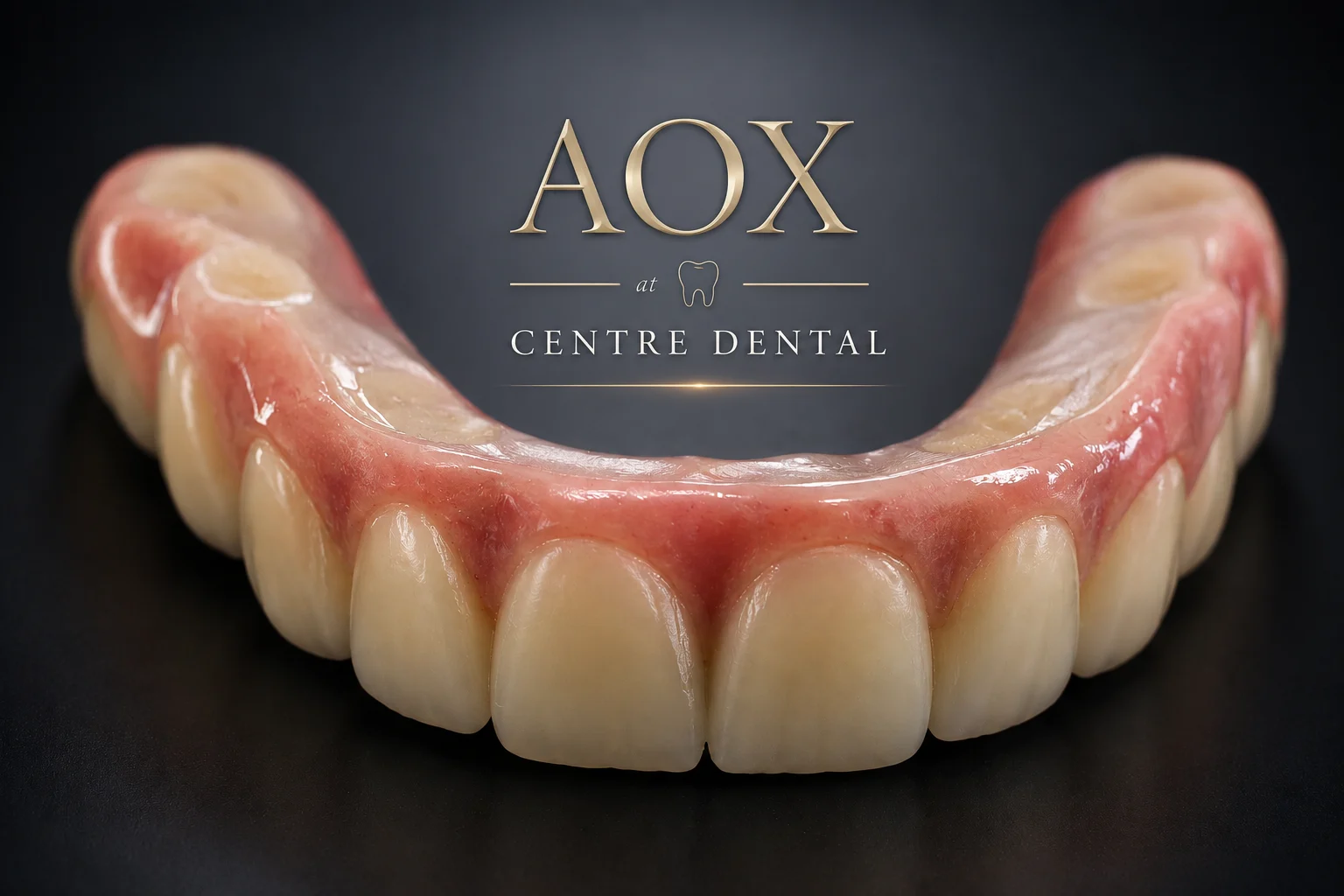
A fixed set of teeth on your own implants — often fitted the same day.
- 94–98%
- All-on-4 implant survival at 6–11 years
- 98.6%
- monolithic zirconia full-arch survival (up to 6 yr)
- 4.9 ★
- 226 Google reviews
Loose dentures and failing teeth wear you down — quietly, every day.
A denture that won't stay put
Adhesive that fails by lunchtime, a lower plate that rocks and lifts, food working its way underneath — a mouth you can never quite trust.
Teeth failing one at a time
Advanced gum disease or repeated breakage, another extraction every year, the slow math of what it costs to keep patching a losing arch.
Eating and speaking hold you back
Cutting food into tiny pieces, avoiding the table with friends, hearing your own speech change — the social cost of a mouth that no longer works.
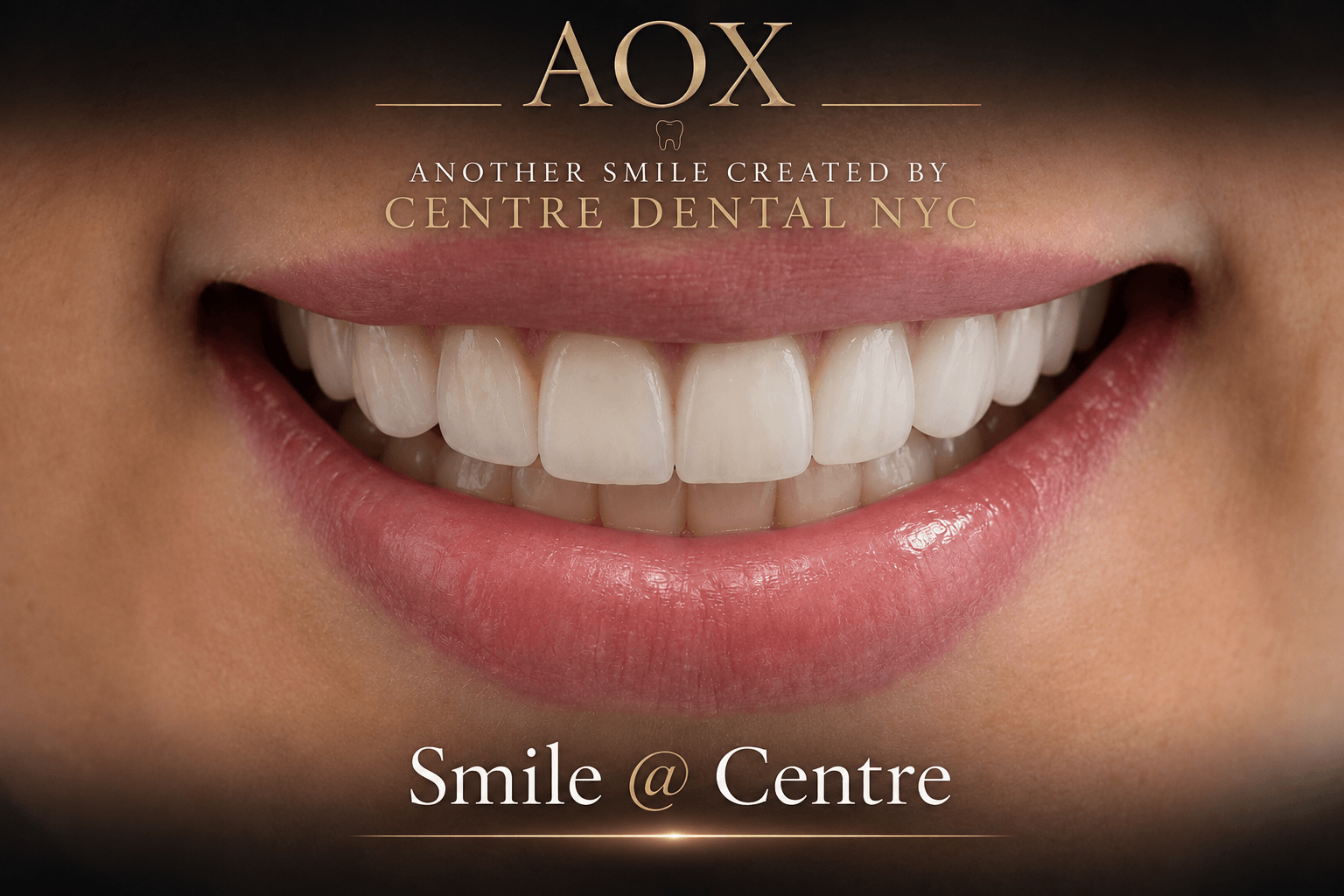
A fixed, full arch of teeth on as few as four to six implants — not a plate you take out at night.
From our operatory
See the treatment, not just the words
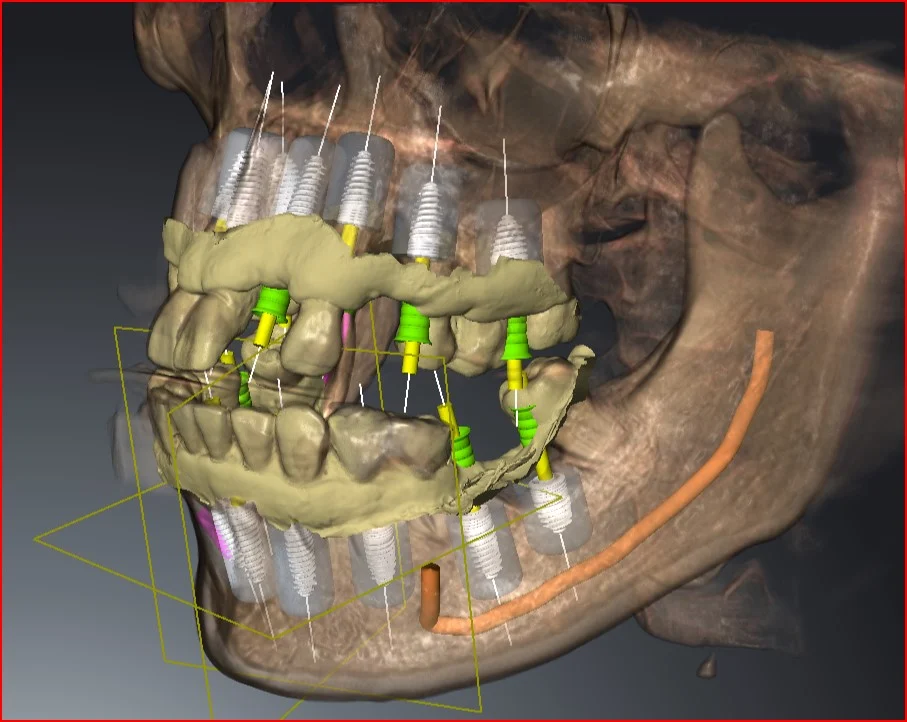
See the CBCT 3D imaging we use to map bone volume and nerve position before any full-arch implant plan is finalized.
Understand it fully
The clinical picture — from four implants to a fixed arch
At a glance
- 94–98%1
- All-on-4 implant survival at 6–11 years
- 98.6%2
- monolithic zirconia full-arch survival (up to 6 yr)
- ~2.4×3
- higher implant failure risk in smokers
What does a fixed full arch actually feel like?
All-on-X replaces a whole upper or lower arch with one complete fixed set of teeth, carried by as few as four to six implants set in your own bone.
Unlike a denture, it doesn't rest on your gums and it doesn't lift when you chew. The prosthesis is screwed down onto the implants, and the bone genuinely grows onto the titanium — osseointegration — which is what makes the result fixed rather than removable.
You don't take it out at night. You look after it in place, and we take it off at maintenance visits when there's a reason to.
It's the full-arch application of the same dental implant biology behind a single implant, planned and placed at our Lower Manhattan office by Dr. Shi.
What is All-on-4, and what is All-on-X?
All-on-4 is the four-implant version of the protocol: two implants placed axially in the front, two tilted posteriorly to carry the back of the arch.
All-on-X is the umbrella. Same fixed-arch concept, but the implant count follows your anatomy — four or six anchor points, decided by bone density, bite forces, and prosthesis design.
That's why two careful offices can look at the same mouth and land on different numbers. Ask either one to show you the bone-density data behind the recommendation.
Dr. Shi frequently places six. The four-implant configuration most patients know as All-on-4 is one option inside the same approach, not a default.
Why are the back implants tilted?
The two angled back implants aren't a shortcut. They're a load-management decision.
In a four-implant arch the prosthesis extends a short distance behind the last implant — a cantilever. Chewing out there acts like a lever and concentrates force on the posterior implants.
Tilting those implants distally, up to 45 degrees, lengthens the effective support and lets them anchor into the thicker cortical bone that persists even as the softer inner bone resorbs after tooth loss. The angle also steers clear of the maxillary sinus above and the inferior alveolar nerve below.
Finite-element studies of full-arch designs consistently show that cantilever length and implant angulation govern how stress reaches the bone. Heavier bite forces or bruxism can warrant six implants, to shorten that cantilever and spread the load.
So implant count is a clinical judgment, not a formula. Your scan sets the number.
94%
Does the research actually back this up?
Yes, and the follow-up runs long enough to mean something.
According to a 2021 systematic review of the All-on-four concept (Gaonkar et al., J Indian Prosthodont Soc), mean cumulative implant survival ran 94% to 98% across follow-ups of six to eleven years.
It found no meaningful difference between the tilted implants and the straight ones, or between the upper and the lower jaw. That's the part worth knowing — the angle isn't a compromise you accept to avoid grafting.
Those figures describe the titanium implants themselves. The prosthesis on top is a separate question, and it's further down this page.
Will you really walk out with teeth the same day?
Most of the time, yes — with a condition attached.
Immediate loading means attaching a fixed provisional arch on surgery day. It depends on the implants achieving enough primary stability at placement, generally a minimum of about 35 Ncm of insertion torque.
That threshold isn't arbitrary. Laboratory work on insertion torque and implant micromotion (Trisi et al., Clin Oral Implants Res, 2010) found that in soft, low-density bone that torque couldn't be reached and micromotion stayed above the risk threshold, whereas in denser bone it stayed safely below.
In plain terms: in firm bone we attach the arch the same day and you leave with teeth. In soft bone — most often the posterior upper jaw — forcing a same-day result invites failure, so we let it heal and fit the provisional a little later.
The share of cases where same-day teeth are achievable is high. It is not 100%, and an office that guarantees it before seeing your scan is overpromising.
Four implants or six — who decides?
Your bone decides. We measure it first.
Bone is classified on the Lekholm and Zarb scale, from Type I dense cortical bone through Type IV soft, low-density trabecular bone. Type I and Type II integrates quickly and holds high placement torque, which makes same-day loading on four implants feasible.
Type III and Type IV grips less firmly and often benefits from additional support. It's most common in the posterior upper jaw. The CBCT scan taken at your consultation measures density at every planned site, so we find the soft zones before surgery rather than during it.
In softer-bone cases, adding a fifth or sixth implant frequently removes the need for the bone grafting that would otherwise be required to build enough stability — which can actually shorten total treatment time instead of adding to it.
What if you've been told you don't have enough bone?
This approach was designed for exactly that situation.
The tilted back implants reach bone that stays intact even after significant atrophy. Plenty of patients who don't qualify for individual single-tooth dental implants turn out to be sound full-arch candidates.
There is still a floor. Where four implants can't achieve safe stability, the honest options are a modest bone augmentation, an All-on-6 configuration spreading load across more anchor points, or in select severe-atrophy upper cases, alternative anchoring strategies.
The same imaging tells us which of those your anatomy actually supports. And if a fixed arch isn't the right answer for you yet, implant-supported overdentures or dentures are a legitimate step rather than a consolation prize.
Who plans your case, and who places the implants?
Dr. Shi does both. It's the question patients rarely think to ask, and it matters more than the brand of implant.
He has placed a large number of full-arch cases, including patients with severe bone atrophy, previously failed implants, and complex medical histories.
Every case starts with a full-arch cone-beam CT scan imported into planning software before a single incision is made. A custom 3D-printed surgical guide, fabricated from that scan, holds each implant on its planned path — the same guided-surgery workflow we use for every implant.
He performs the surgical and the prosthetic phases himself. The person designing your bite and the shape of the final arch is the person who placed the implants, which removes the handoff error that can creep in between a separate surgeon and prosthodontist. More about Dr. Shi.
Your next step
Wondering if all-on-x full-arch implants is right for you?
A free consultation includes an exam and a written plan — no pressure, no upsell.
What would make you a poor candidate?
You'll hear this at the consultation, before a plan is ever finalized — not after.
Smoking is the big one. According to a systematic review and meta-analysis (Mustapha & Chrcanovic, Medicina, 2021), implants placed in smokers failed at roughly 2.4 times the rate of those in non-smokers.
Active gum disease gets stabilized first, and so does anything in your medical history that affects healing. We'd rather work through those than around them.
None of this is a door closing. It's the candid part of the conversation, and it belongs at the start.
What are the new teeth made of?
Two materials, at two stages.
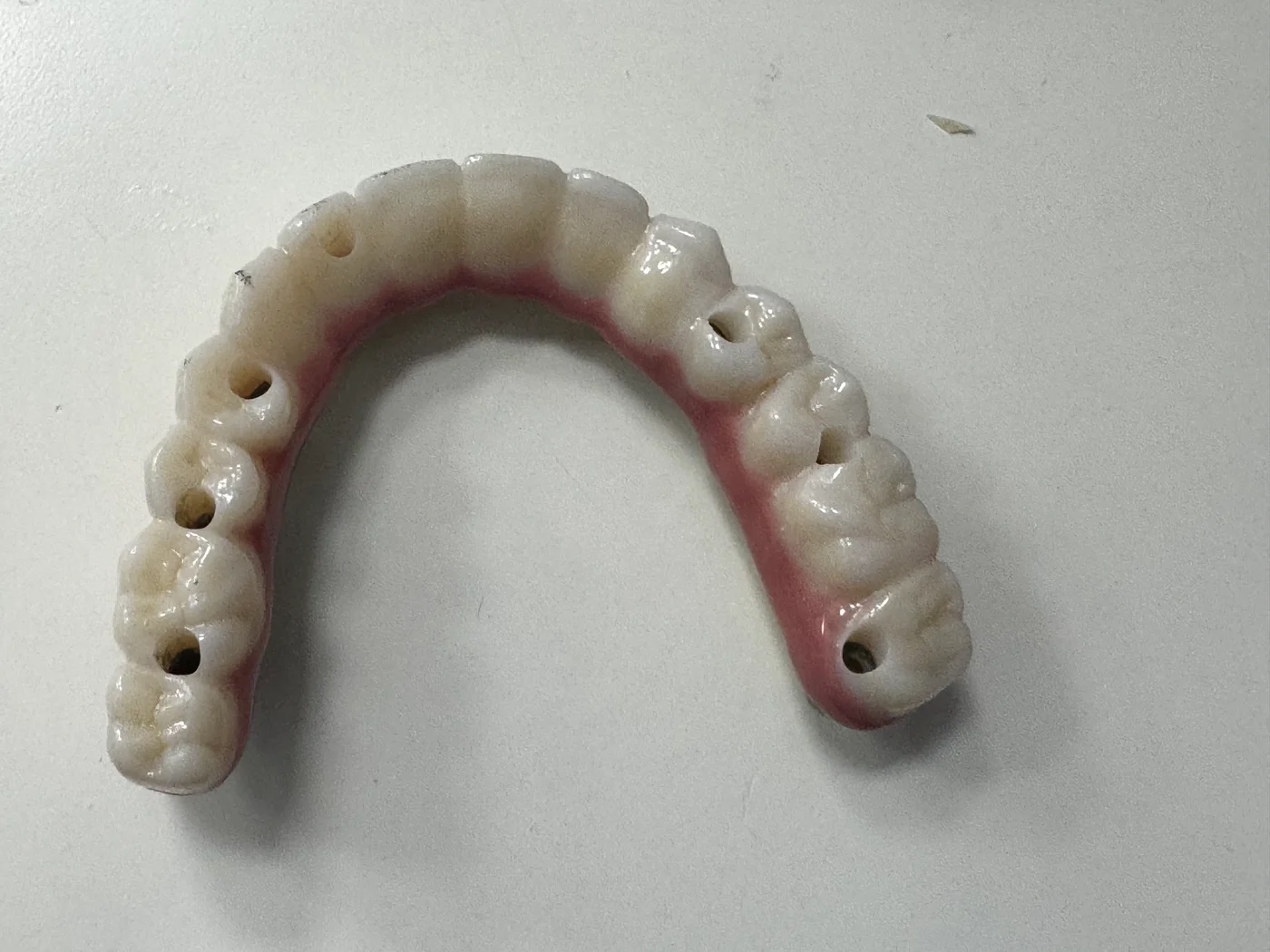
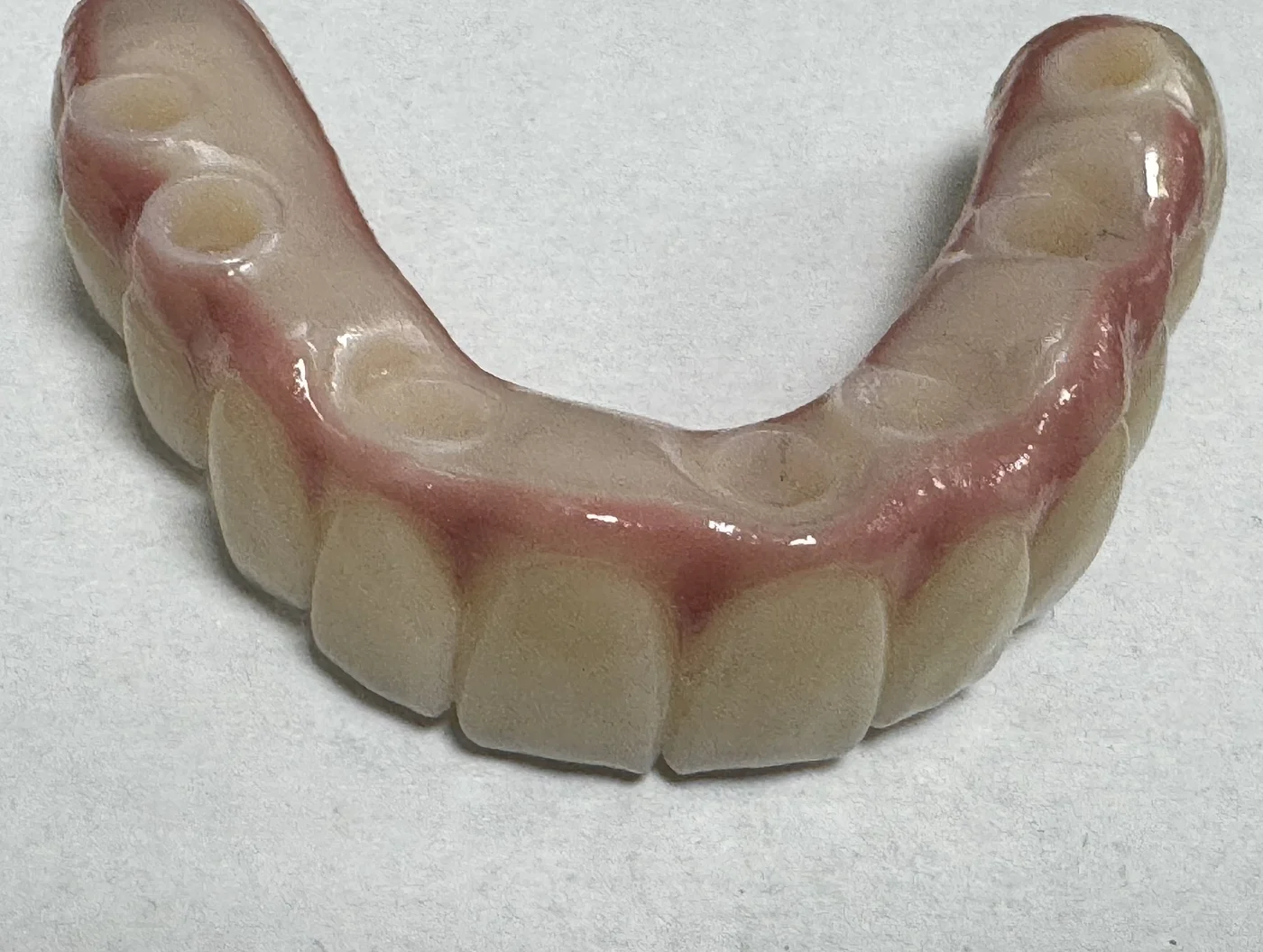
Through the roughly four to six months of osseointegration you wear a provisional arch, typically acrylic (PMMA) reinforced with a titanium bar. It's lighter and straightforward to adjust while the bone heals.
The final prosthesis is usually full-contour monolithic zirconia — zirconium dioxide — which stands up far better to heavy, long-term bite forces.
The durability data is genuinely reassuring. According to a study of 115 monolithic zirconia full-arch prostheses (Papaspyridakos et al., J Prosthodont, 2024), survival was 98.6% at up to six years, with only two fractures across the whole series.
What surprises people in the first few weeks?
Two things. Neither is a problem, and both are worth hearing in advance.
First, a small gap tends to open between the prosthesis and the gum as the soft tissue heals and reshapes. It traps food, and nearly everyone notices it. It settles as the contours stabilize.
Second, D, F, and S sounds often shift for a few weeks while your tongue learns the new anatomy.
Both are normal and temporary. Knowing to expect them is what keeps them from becoming alarming.
Can you eat and speak normally again?
That's the whole point of the treatment.
A finished arch functions much like natural teeth for eating and speaking. No cutting food into small pieces, no working out in advance which side of your mouth can take it.
Because it's fixed to the implants, it doesn't rock or lift while you talk — the failure that makes a loose denture exhausting to live with year after year.
Speech settles inside the first few weeks, as above, and most patients stop thinking about the arch entirely.
How do you look after a set of teeth you can't take out?
Differently from natural teeth. It takes about a week to become automatic.
Standard floss won't reach underneath. The daily tools are a soft-bristle brush, a water flosser aimed at the gum-prosthesis interface, and interdental brushes sized to slip beneath the arch.
Plaque on the tissue side of the prosthesis is the main driver of peri-implant inflammation, so that surface is the one needing attention every day.
Professional maintenance cleanings every three to six months back that up, using instruments safe for implant and zirconia surfaces.
1.6 mm
How long does it last, and what does upkeep involve?
The implants carry long-term survival data. The prosthesis is the part you maintain.
Screws can occasionally loosen and materials wear over the years. Because the arch is cross-arch stabilized, complete prosthesis failure is uncommon. Since switching to 1.6 mm screws and monolithic zirconia bridges, Dr. Shi sees less than 2% prosthetic issues in his own cases, mostly occasional screw loosening.
So it isn't quite permanent the way a single crown is. Treat it as something maintained, not bought once.
Skipping maintenance is the single most common reason an otherwise successful case runs into trouble years later. If you grind, a night guard protects the investment.
What does the timeline look like, start to finish?
Consultation and full-arch CBCT scan. Bone volume, density, sinus position, and nerve pathways, mapped across the whole arch. You leave with a clear timeline and a written cost and insurance estimate.
Your guided surgical plan. A custom 3D-printed surgical guide built from your scan, so every implant is placed on its planned path and angle. If a small graft is genuinely needed for stability, it's staged honestly — only when the scan shows it, never as an upsell.
Placement, and a provisional arch when stability allows. Implants placed by Dr. Shi himself, torque-controlled. When primary stability reaches the clinical threshold, the fixed provisional arch is attached the same day.
Osseointegration, then your final arch. Roughly four to six months for the implants to fuse with bone. Then the full-contour monolithic zirconia arch is fitted — color-matched, contoured to your bite, built for years of normal function.
Booking a consultation in Lower Manhattan
Your first visit is a consultation and a full-arch CBCT scan. Nothing gets decided before we've looked at your bone.
You'll leave knowing whether a fixed arch suits your anatomy, whether that points to four implants or six, what each phase costs in writing, and how long the whole thing should take.
We're a non-participating provider with most PPO plans and will give you an honest read of what your benefits will and won't cover. Financing can spread the cost over time.
We see patients in English and 中文. Start with our contact page.
Related at Centre Dental
What patients say
Reviewed, on Google
I came for an emergency root canal treatment and I did not regret choosing this place. It was quick and painless. Plus, everyone was very quite friendly.
I recently had a dental cleaning at Centre Dental, and I had a wonderful experience. The staff was friendly, professional, and welcoming. The cleaning was very thorough yet gentle, and everything was explained clearly th…
A skillful Dentist who goes the Extra Miles I have been flying to NYC from Florida multiple times to this dental office. Dr. Shi has been working on my upper full mouth teeth transplant for over half a year. So far I ha…
Concerned about comfort, bone, or cost?
These are the questions a consultation answers directly. Dr. Shi reviews your 3D CBCT scan, evaluates your bone and candidacy, and outlines your options, treatment timeline, and estimated cost — including what your insurance may cover.
Thinking about it
The questions we hear first
Will I really leave with teeth the same day?
How long do All-on-4 implants actually last?
What is the difference between All-on-4 and All-on-X?
Is All-on-4 suitable if I've lost a lot of bone?
How is All-on-4 different from traditional dental implants?
How much does All-on-4 cost per arch in NYC?
Does insurance cover All-on-4?
Can patients travel from outside NYC for All-on-4?
The path
Your journey, start to finish
Consultation + full-arch CBCT scan
Your guided surgical plan
Placement + same-day provisional (when stability allows)
Osseointegration + your final zirconia arch
CBCT-driven planning before any incision
Full-arch reconstruction at Centre Dental starts with a CBCT-driven assessment of bone volume in both jaws. The number of implants — four, six, or eight per arch — is decided by where dense bone exists, not by a fixed protocol number. Some patients have enough bone in the anterior maxilla and parasymphyseal mandible to support All-on-4. Others need the additional posterior anchorage that six or eight implants provide.
Once implants integrate, the prosthesis can be fabricated in zirconia (highest strength and aesthetics, premium cost), monolithic acrylic (immediate provisional, lower long-term durability), or hybrid titanium-acrylic (the original Brånemark approach, durable but bulkier). Dr. Shi sequences the conversion from immediate provisional to definitive prosthesis based on tissue healing, not a fixed calendar date.
Inside Our Practice
See it in action
Explore the Cluster
Explore the full Dental Implants
Explore Further
Related Services
Dental Implants
Single-tooth and multi-tooth implants — the 3D-guided science behind every full-arch case.
Learn moreImplant-Supported Overdentures
A removable, implant-stabilized arch — a more affordable entry point, convertible to fixed later.
Learn moreDentures
Traditional and premium dentures for patients not yet ready for a fixed implant arch.
Learn moreMeet Dr. John Shi, DDS
Columbia-trained, with extensive full-arch implant experience.
Learn moreAll-on-X Full-Arch Implants Near You in NYC
Start here
Schedule your consultation
In a single visit, Dr. Shi reviews your 3D scan, assesses your candidacy for all-on-x full-arch implants, and provides a written treatment plan with cost and insurance details — so you can decide with all the facts.
Extensive full-arch reconstruction experience by Dr. Shi
3D-guided precision, placed by an experienced surgeon
Bilingual — English, Mandarin, Cantonese
Live clinic hours · 139 Centre St, Lower Manhattan, NYC