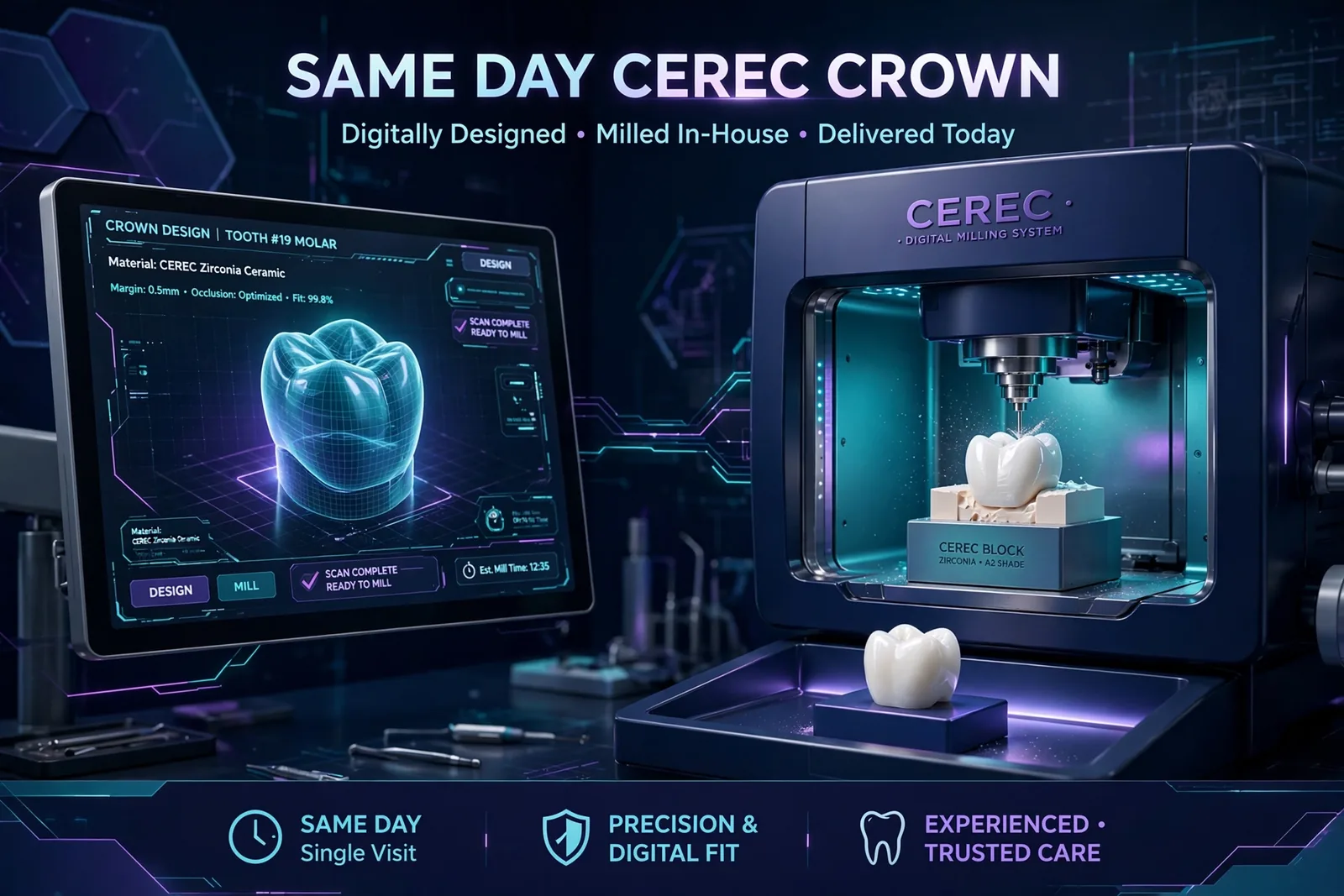

Same Day Crowns NYC — CEREC Porcelain Crown in One Visit
Walk in with a broken tooth. Walk out with a finished one — the same afternoon.
Single-visit CEREC porcelain crowns in NYC by Dr. John Shi. One appointment, no temporary crown, no second visit — a permanent, color-matched restoration designed, milled, and cemented while you wait.

A cracked or worn-down tooth doesn't wait for your calendar.
Most people who come to us for a crown aren't weighing lithium disilicate against zirconia — they just want to stop babying a tooth on one side of their mouth, or they're dreading the two-week gap between the drill and the delivery. If that's you, you're in the right place. Same-day CEREC compresses the whole thing into a single visit. Below is everything worth understanding before you sit down — in plain language, with the honest trade-offs included.
The two-visit ordeal
A drilled-down tooth, a gooey impression, then a temporary crown to guard for two weeks until the lab sends the real one back.
A temporary that lets you down
Temporaries pop off at dinner, catch floss, and leave a sensitive tooth exposed — right when you can least afford the disruption.
A crown that looks 'off'
Too flat, too opaque, the wrong shade — an unnatural crown you notice every time you smile in a mirror.
A permanent porcelain crown, designed and placed in one sitting.
A CEREC crown replaces the traditional impression-and-lab workflow with an in-office digital one: a 3D intraoral scan captures your prepared tooth, design software shapes the crown to your bite and neighboring teeth, and an on-site milling unit cuts it from a solid ceramic block that's then fired, polished, and cemented the same day. No impression tray, no temporary to manage, no second appointment off work. The result is a full-strength porcelain crown — the difference is that you keep your afternoon instead of your calendar keeping you.
Book a same-day crown consultationFrom our operatory
See the treatment, not just the words
From scan to seated crown in one visit: watch a porcelain crown designed, milled, and finished in our operatory.
Understand it fully
The clinical picture — from digital scan to cemented crown
At a glance
- 91–100%1
- monolithic zirconia crown survival
- 1.84×2
- CAD/CAM vs conventional failure risk (pooled)
- 80.1%3
- chairside lithium disilicate survival at 15 yrs
What a CEREC crown actually is
CEREC — Chairside Economical Restoration of Esthetic Ceramics — is a digital workflow that lets a dentist design and fabricate a full ceramic crown entirely within the office during a single appointment. An intraoral 3D scanner replaces the traditional impression tray and the polyvinyl-siloxane putty that goes with it, capturing a precise digital model of the prepared tooth. Design software then shapes the crown geometry to match your bite and the teeth on either side. The restoration is milled from a solid block of dental ceramic — either lithium disilicate or zirconia — then fired, polished, and cemented the same day. It's the same category of restoration a lab would make; what changes is where and how fast it's made. Every case here is planned and placed by Dr. John Shi using the process we call the Centre Method.
What the research honestly shows about same-day crowns
The convenience of CEREC is real, and so is a nuance worth knowing before you decide. According to PubMed, a 2019 systematic review and meta-analysis in the Journal of Prosthodontic Research (Rodrigues et al.) found that CAD/CAM ceramic restorations carried a 1.84× higher failure risk than conventionally fabricated ones in pooled data drawn from 14 clinical trials. That figure reflects wide variation in operator technique across many practices — it is not a verdict that same-day crowns are inferior in skilled hands. The counterweight is strong: a separate 2021 systematic review found monolithic tooth-supported zirconia single crowns survived at 91% to 100% across nine studies, and a 15-year chairside lithium disilicate study reported 80.1% survival at more than fifteen years of service. The honest reading is this: a same-day crown, milled from the right material by an experienced clinician, performs predictably for a decade or more — but operator experience and material choice matter, and any practice offering CEREC should be transparent about that.

Your next step
Wondering if same-day crowns (cerec) is right for you?
A free consultation includes an exam and a written plan — no pressure, no upsell.
Choosing the material — lithium disilicate vs zirconia by tooth position
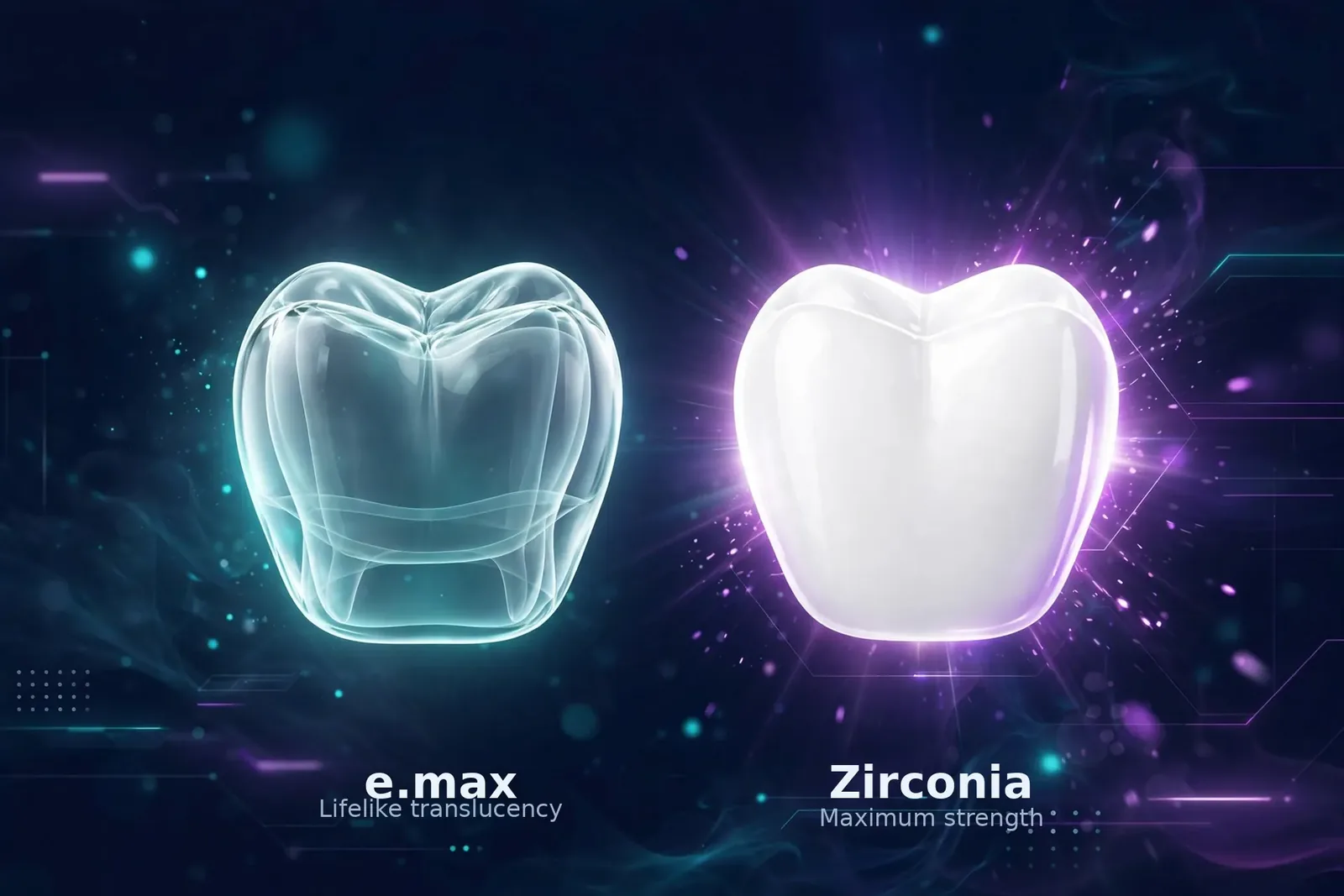
Not every CEREC crown is milled from the same block, and material selection is the single most consequential decision in a same-day restoration. It should be driven by where the tooth sits and the forces it absorbs — not by what's convenient. Lithium disilicate (the IPS e.max glass-ceramic) has a flexural strength around 500 MPa and light-transmission properties that closely mimic natural tooth enamel, which makes it the preferred choice for front teeth and premolars where appearance leads. Full-contour zirconia — a form of the ceramic zirconium dioxide — reaches roughly 1,000 MPa, about twice the strength, which makes it the right call for posterior molars under heavy chewing load or for patients who grind. A 'flat-looking' crown, one of the most common complaints about same-day work, almost always traces to material selection and contour design rather than the CEREC technology itself. If you're also considering thinner cosmetic restorations for the front teeth, porcelain veneers are a different tool for a different job — we'll tell you which one your case actually calls for.
When CEREC is — and isn't — the right choice
Same-day CEREC suits most single-unit restorations: large decay, a cracked tooth, coverage after a root canal, and the replacement of a large failing filling where too little healthy enamel remains to rebuild directly. The technology is well-validated for these indications. Cases still better served by a dental laboratory include complex multi-unit bridges that need precise interarch coordination, some implant-level restorations where prosthetic components add design complexity, and severely broken-down teeth where occlusal planning benefits from a technician's direct involvement. Patients who grind heavily are excellent CEREC candidates — specifically when zirconia is selected, not when a glass-ceramic is placed in a high-stress molar position. Before anything is prepared, we review radiographs and photograph the tooth to confirm both candidacy and the correct material for your anatomy.

Have questions?
Talk it through with Dr. Shi before you decide.
A free consultation includes an exam and a written plan — no pressure, no upsell.
What happens in the appointment, step by step
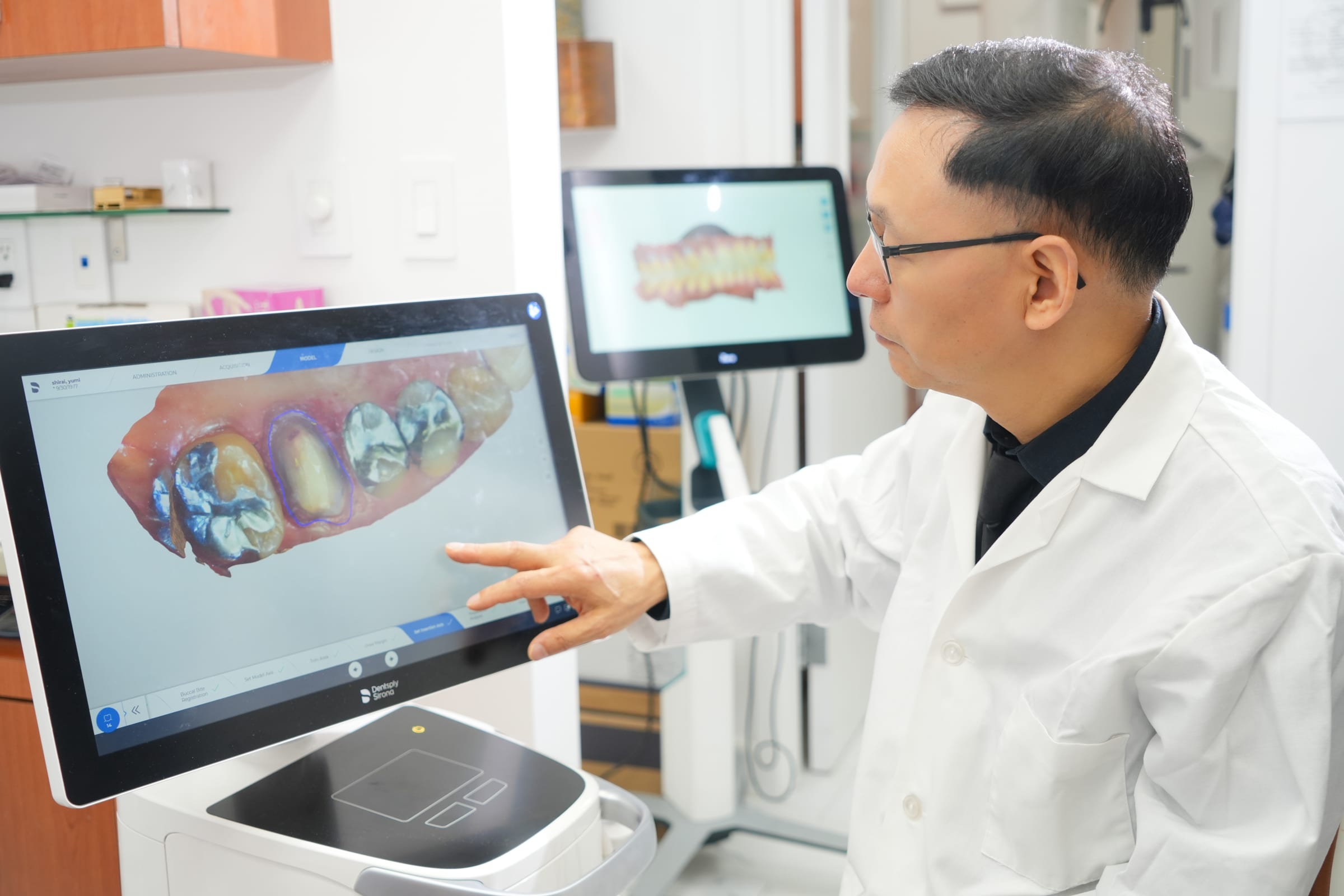
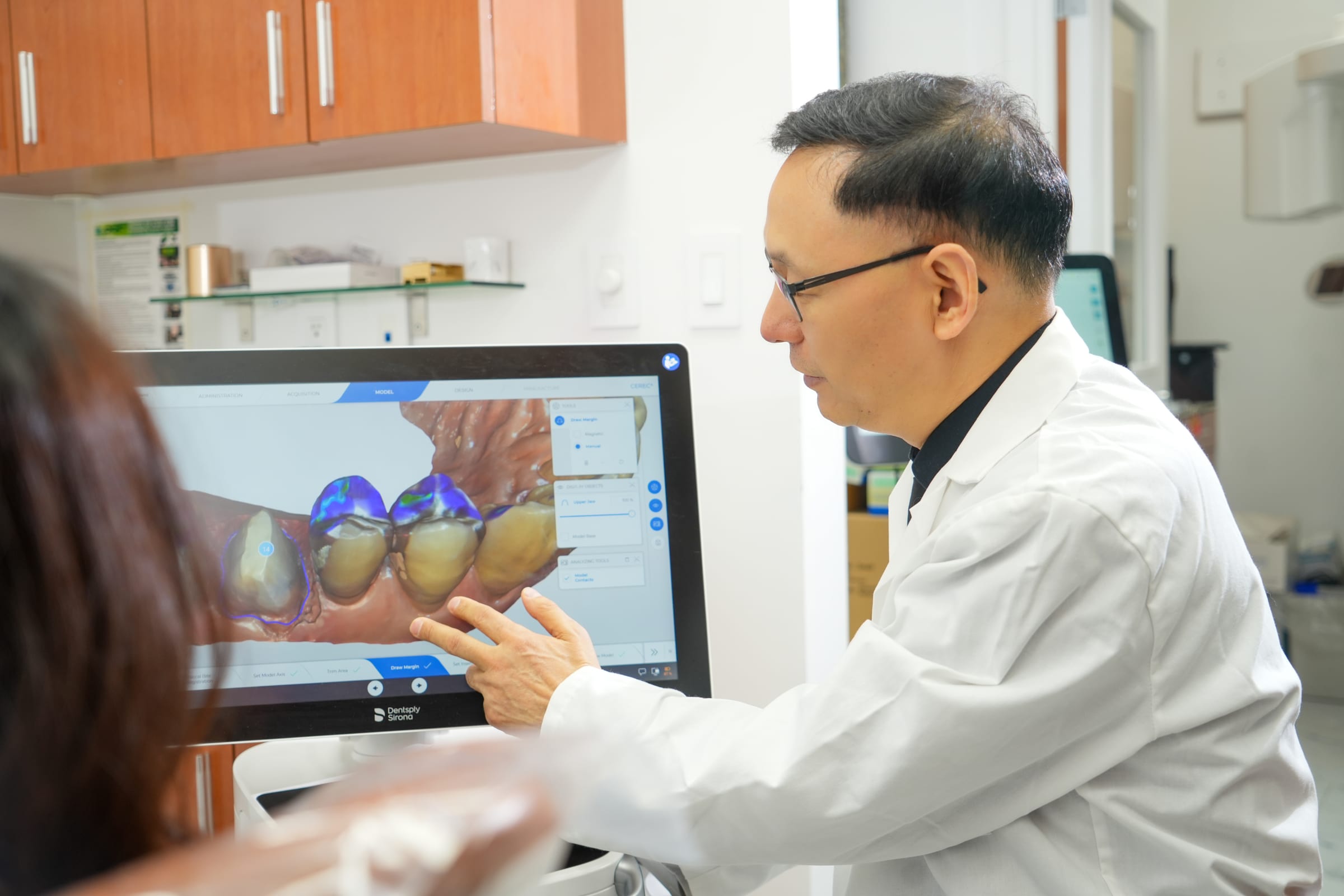
A same-day crown visit runs, in most cases, 90 to 120 minutes from start to finish. First, the tooth is prepared under local anesthesia — shaped to receive the crown and cleared of any decay or failing restoration. Next, a digital scan captures the prepared tooth and the opposing bite in a few minutes, replacing the impression tray entirely. The crown is then designed on-screen while you sit, and the design is sent to the on-site milling unit, which cuts the restoration from a ceramic block in roughly 15 minutes. After milling, the crown is stained, glazed, and fired to its final strength and shade, then tried in and checked for fit, contact, and bite before it is bonded into place. If a contour or bite contact needs refining after milling, that adjustment happens chairside — you don't leave and come back. You read more about the imaging and CAD/CAM technology behind this workflow on our technology page.
Why crowns fail — and how the margin and the bite decide longevity
Whether a crown was milled chairside or in a lab is rarely what determines how long it lasts. Three things do. The first is the margin — the fine seam where the crown meets your natural tooth at the gum line. Plaque that collects there is what drives recurrent decay and gum inflammation under an otherwise sound crown, which is why home care at the margin matters as much as the crown itself. The second is the bite: an unbalanced occlusion concentrates force on one part of the ceramic and invites fracture over time. The third is grinding. Untreated bruxism dramatically shortens the life of any crown regardless of material, which is why we address it directly rather than ignoring it — often with a custom night guard. Get those three right, and a well-chosen ceramic crown behaves like part of your own tooth for many years.
Same-day crowns as part of a whole-mouth plan
A crown rarely exists in isolation. The tooth that needs one often needs the cause addressed too — the cavity that undermined it, the grinding that cracked it, or the gum health at its base. That's why we plan a crown as one piece of the whole picture rather than a one-off repair. Where decay is caught early and coverage isn't yet needed, a conservative filling or Solea laser treatment may be the better first move. Where a tooth is beyond saving, a crown gives way to a dental implant and a crown on top of it. The point of the consultation is to match the right restoration to the right tooth — and to be honest when a same-day crown isn't the answer.
Related at Centre Dental
Concerned about comfort, bone, or cost?
These are the questions a consultation answers directly. Dr. Shi reviews your 3D CBCT scan, evaluates your bone and candidacy, and outlines your options, treatment timeline, and estimated cost — including what your insurance may cover.
Thinking about it
The questions we hear first
What exactly is a CEREC same-day crown?
CEREC is a chairside digital system that lets a dentist design and mill a full ceramic crown during a single office visit. A 3D intraoral scanner replaces traditional impression material, and an on-site milling unit fabricates the crown from a solid ceramic block — either lithium disilicate or zirconia, chosen for your tooth position and bite. The finished restoration is cemented the same day, with no external laboratory involved and no temporary crown to manage in between. The convenience is genuine; outcomes depend on the clinician's experience with the system and on the right material being chosen for your specific tooth.
How long does a same-day crown appointment take?
Most same-day crown visits run 90 to 120 minutes from preparation through cementation. The milling itself takes roughly 15 minutes; the rest of the time covers tooth preparation under local anesthesia, the digital scan, chairside design review, glazing and firing, and fit and bite verification. You don't return for a second delivery appointment. If a contour or bite contact needs refining after milling, that's handled chairside before the crown is bonded.
Are same-day crowns as good as lab-made crowns?
In the hands of an experienced operator, yes — with honest nuance in the data. According to a 2019 systematic review, CAD/CAM ceramic restorations carried a 1.84× higher failure risk than conventional ones in pooled data, a figure that reflects wide variation in technique across many practices rather than a flaw in the technology. Balanced against that, monolithic zirconia single crowns have shown 91–100% survival across studies, and chairside lithium disilicate crowns 80.1% survival at more than fifteen years. What CEREC reliably saves you is time: one appointment, no temporary crown, no second visit.
Lithium disilicate or zirconia — which material is right for my crown?
Material choice is the most consequential decision in a same-day crown, and it follows tooth position and bite load, not convenience. Lithium disilicate (e.max) has a flexural strength around 500 MPa and the best natural light transmission — ideal for front teeth and premolars where appearance leads. Zirconia reaches roughly 1,000 MPa, about twice the strength, making it the right choice for posterior molars under heavy load or for patients who grind. Placing a glass-ceramic on a high-stress molar is a common source of early failures. Your dentist confirms the material before any preparation begins.
Can I get a same-day crown if I grind my teeth?
Yes — with the right material and a plan for the grinding itself. Patients with bruxism should receive zirconia crowns, not lithium disilicate, when back teeth are involved; zirconia's much higher strength resists the cyclic force of nighttime grinding far better. Just as important, the grinding has to be managed, because unmanaged bruxism raises the long-term failure risk of any crown regardless of material. We typically recommend a custom night guard to protect both the new crown and the opposing teeth.
How long will a same-day crown last?
With appropriate material selection and good care, a same-day ceramic crown is expected to last many years — monolithic zirconia single crowns have shown 91–100% survival across studies, and chairside lithium disilicate 80.1% survival at more than fifteen years of service. Longevity is decided mostly by three things we control together: the fit of the margin at the gum line, a balanced bite, and how well you keep the gum line around the crown clean. Whether it was milled chairside or in a lab is rarely the deciding factor.
Does dental insurance cover CEREC crowns, and what will it cost?
Most dental plans with major restorative coverage treat a CEREC crown the same as a conventionally fabricated one — the fabrication method is usually not a coverage distinction, and cost is driven mainly by tooth location and clinical complexity rather than by chairside versus lab. We verify your benefits before your appointment and give you a written estimate, along with financing options if you'd prefer to spread the cost, so you have a clear picture of your out-of-pocket amount before any preparation begins.
Why do some same-day crowns look flat or unnatural?
A flat, opaque, or 'off' crown is one of the most common complaints about same-day work — and it's almost always a design and material issue, not a limitation of CEREC itself. Monolithic zirconia milled without adequate characterization can look opaque; lithium disilicate, glazed skillfully, is often indistinguishable from natural enamel. The chairside design step — where contour, cusp anatomy, and shade are matched — is where those distinctions are made. Every crown here goes through a detailed fit and appearance review before it's cemented, and a genuine mismatch is corrected before you leave, not after.
The path
Your journey, start to finish
Consultation + digital scan
We review the tooth on radiographs and photos, confirm a crown is the right call, and — if it is — take a 3D intraoral scan. Dr. Shi explains your material options and gives you a written cost and insurance estimate before anything is prepared.
Preparation + design
The tooth is prepared under local anesthesia and any decay or failing restoration is cleared. The prepared tooth is scanned, and your crown is designed on-screen to match your bite and neighboring teeth — with the material chosen for its position and load.
On-site milling + glaze
The design is sent to the in-office milling unit, which cuts the crown from a solid ceramic block in about 15 minutes. It's then stained, glazed, and fired to its final shade and full strength while you wait.
Fit, bite check + same-day cementation
The crown is tried in and checked for fit, contact, and bite; any refinement is done chairside. Once it's right, Dr. Shi bonds it into place — and you leave with a finished, permanent tooth the same day.
Why a same-day crown changes the patient experience
A traditional crown takes two appointments separated by two-to-three weeks: prep + impression + temporary crown at visit one, then cement the lab-fabricated permanent at visit two. Centre Dental compresses that into a single visit using a CEREC Primemill milling unit paired with a 3Shape TRIOS intraoral scanner. The TRIOS scanner captures the prepared tooth, the design software builds the crown digitally in roughly fifteen minutes, the Primemill cuts the porcelain block, and the crown is bonded the same day.
Same-day delivery removes the temporary-crown phase entirely — no risk of the temp coming loose, no chewing restrictions during the wait, and no second-injection appointment.
Adjusting contacts, occlusion, and emergence in software
Inside the design software the crown begins as a starting proposal generated from the scanner data and the patient’s existing bite. Dr. Shi adjusts contact points, occlusal anatomy, and emergence profile against the opposing arch — the same parameters a master ceramist would refine by hand at a traditional lab, executed in software with millimeter precision.
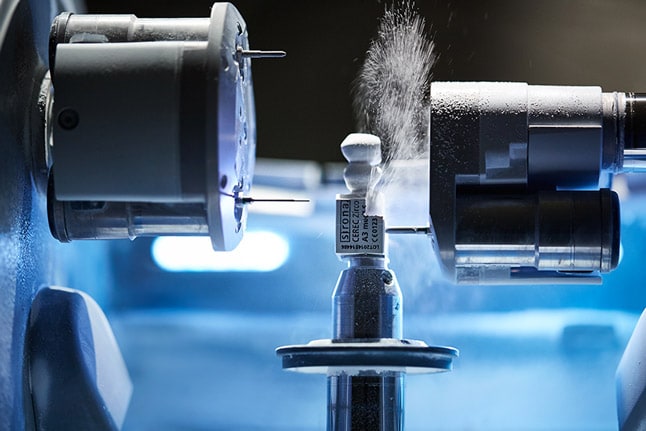
The chosen ceramic block — typically lithium disilicate (Emax) for anterior aesthetics or zirconia for posterior strength — is loaded into the Primemill unit. Milling takes roughly fifteen minutes for a single-tooth crown. After milling, the crown is fired in a sintering oven for full strength, polished, and bonded the same visit. The two-week lab-turnaround gap of traditional crowns disappears entirely.
Inside Our Practice
See it in action
Explore Further
Related Services
Dental Implants
When a tooth can't be saved with a crown — precision replacement guided by 3D imaging and a custom surgical guide.
Learn morePorcelain Veneers
Thin ceramic restorations for front teeth — a different tool from a crown for chips, gaps, and discoloration.
Learn moreSolea Laser Dentistry
Anesthesia-free cavity treatment for most patients — often the conservative step before a crown is ever needed.
Learn moreNight Guard for Bruxism
A custom guard that protects your crown and opposing teeth if you grind — key to long-term crown survival.
Learn moreSame-Day Crowns (CEREC) Near You in NYC
Start here
Schedule your consultation
In a single visit, Dr. Shi reviews your 3D scan, assesses your candidacy for same-day crowns (cerec), and provides a written treatment plan with cost and insurance details — so you can decide with all the facts.
Extensive full-arch reconstruction experience by Dr. Shi
3D-guided precision, placed by an experienced surgeon
Bilingual — English, Mandarin, Cantonese
Live clinic hours · 139 Centre St, Lower Manhattan, NYC