

Night Guard NYC — Custom Guards for Teeth Grinding and Clenching
Wake up with a sore jaw or a headache you can't explain? Your teeth may be working all night.
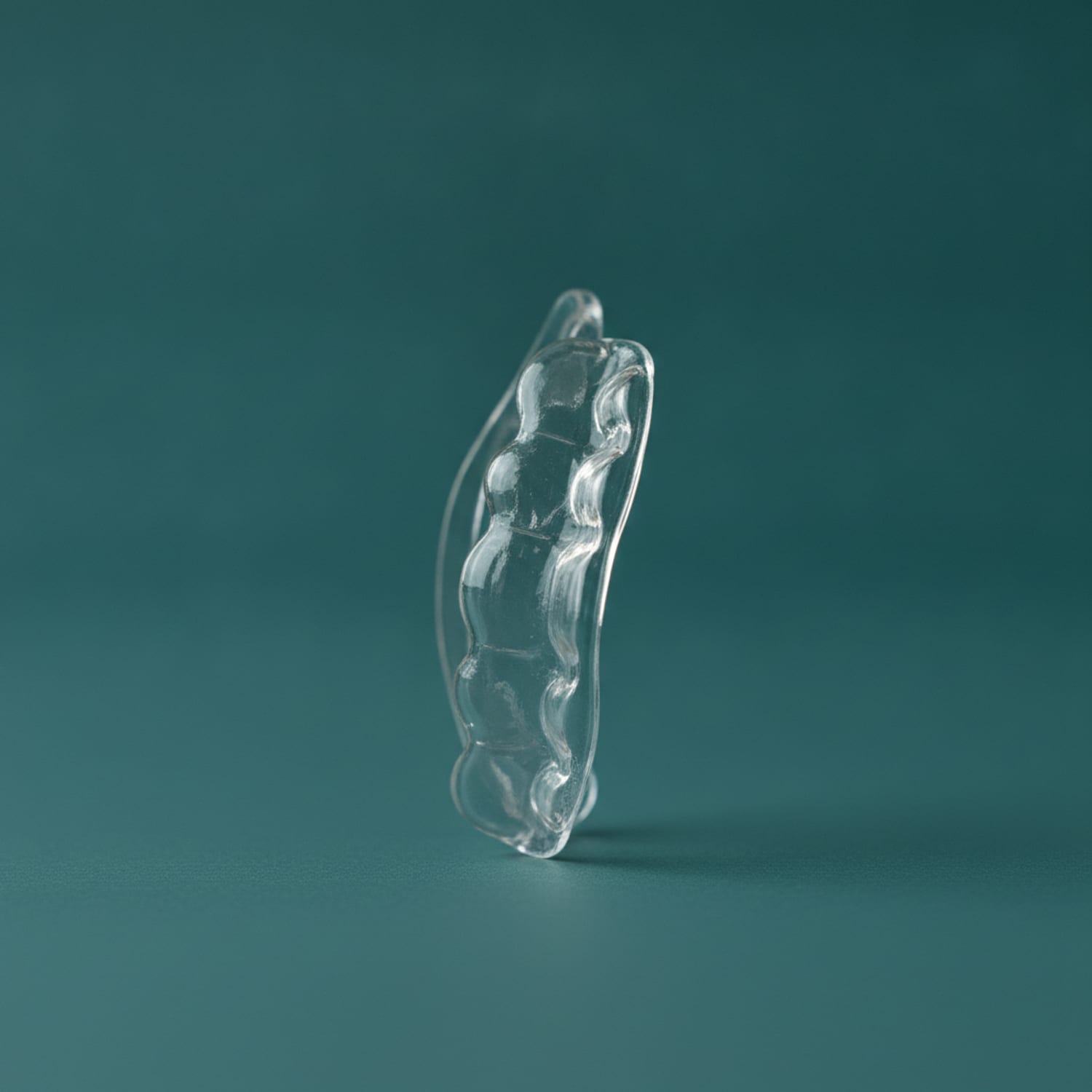
Custom-fitted night guards for teeth grinding and clenching in NYC, designed and balanced by Dr. John Shi. A thin, precise guard that protects your teeth, eases your jaw, and that you'll actually wear.

Grinding is silent until the damage isn't.
Most people who grind their teeth have no idea they do it — until a partner mentions the sound, or we point out the flattened edges at a checkup. By then, years of nighttime force have already reshaped teeth, strained the jaw joint, and set up cracks that turn into crowns. You don't feel it happening. You feel the aftermath: the tired jaw, the morning headache, the chipped tooth that seemed to come from nowhere. Below is everything worth understanding before you decide, in plain language.
You wake up already tired
Morning jaw soreness, temple headaches, or a face that feels tense before the day even starts — the hallmark of a night spent clenching.
Your teeth are quietly wearing down
Flattened canines, chipped edges, and hairline cracks that creep toward the gum line — damage that compounds so slowly any single year looks fine.
A tooth cracked out of nowhere
A filling that keeps failing or a molar that fractured with no obvious cause is often the endpoint of years of unprotected grinding force.
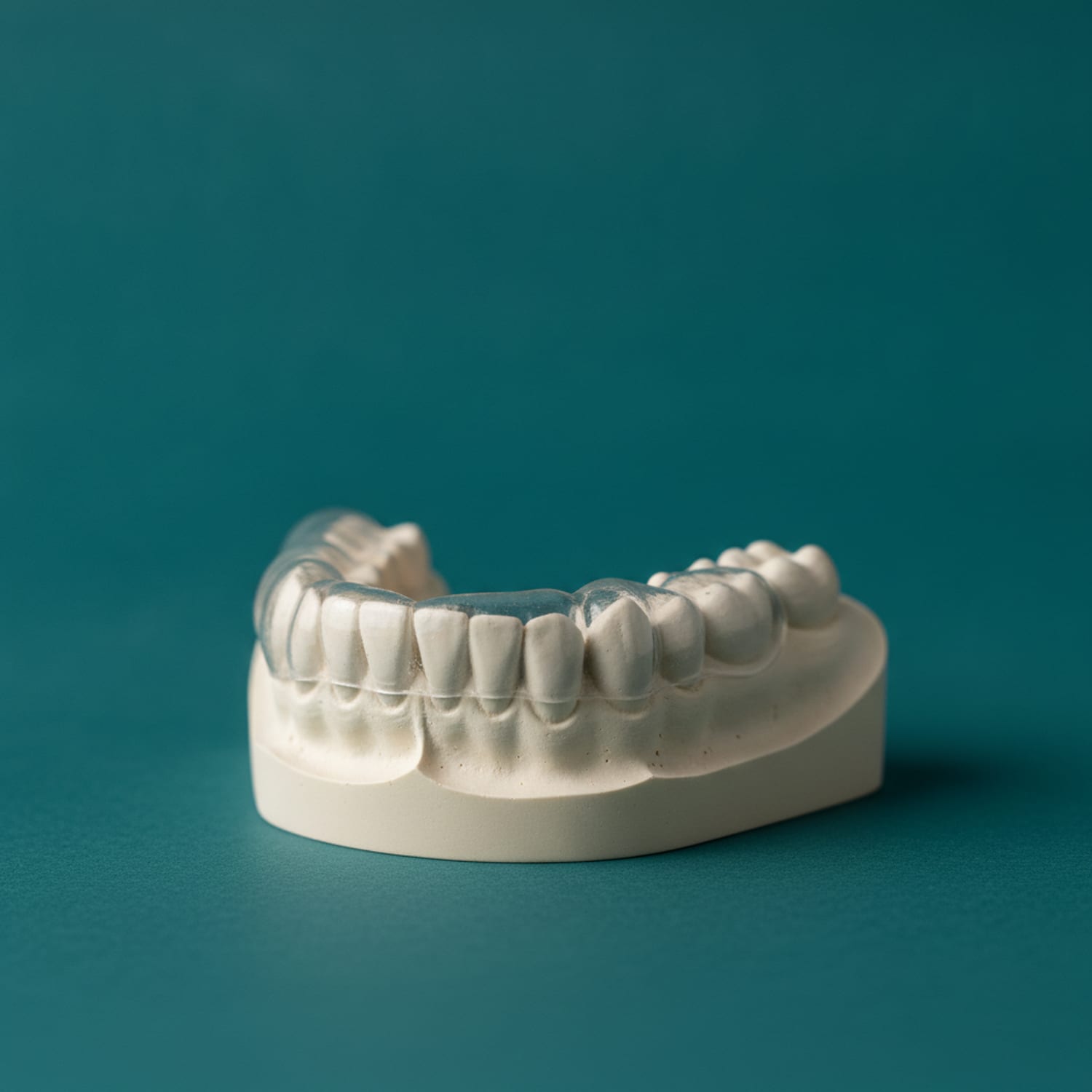
A custom barrier that absorbs the force your teeth would otherwise take.
A night guard is a precisely fitted acrylic shell worn over your teeth while you sleep. It doesn't stop your brain from grinding — bruxism has deeper roots in stress, airway, and sleep patterns — but it intercepts the load, so the force lands on a replaceable piece of acrylic instead of your enamel, your fillings, and your jaw joint. Done right, it's equilibrated so every opposing tooth meets the guard at the same instant and side-to-side movements glide smoothly on the canines. That balance is the whole point: it eases muscle strain, protects the teeth you have, and is comfortable enough that you keep wearing it.
Schedule a night guard consultationUnderstand it fully
The clinical picture — from muscle to enamel
At a glance
- ~21%1
- global sleep bruxism prevalence
- ~39%2
- of adults with sleep apnea also grind
What bruxism actually is — and why you may not know you have it
Bruxism is the repetitive clenching or grinding of teeth, and the sleep form (sleep bruxism) is driven not by conscious habit but by brief bursts of jaw-muscle activity called rhythmic masticatory muscle activity, often tied to micro-arousals during sleep. Because it happens while you're unconscious, most people are genuinely unaware of it until someone hears the grinding or a dentist recognizes the wear. It's common: according to PubMed, a 2024 systematic review and meta-analysis put the global prevalence of sleep bruxism at roughly 21% of the population. The muscles involved — chiefly the masseter and temporalis — are among the strongest in the body relative to their size, which is why nighttime grinding, sustained over years, does real structural damage that ordinary chewing never would.
How grinding damages teeth, gums, and the jaw joint over time
Unprotected bruxism works on several fronts at once. On the biting surfaces, it flattens and polishes enamel until canines and premolars lose their natural peaks. At the gum line, the lateral flexing force creates wedge-shaped notches (abfraction lesions) and contributes to recession on otherwise healthy gums. Inside the tooth, repeated loading propagates micro-cracks that can eventually split into a fracture needing a crown — or worse. And the temporomandibular joint and the muscles around it absorb the strain, producing the morning tension, temple headaches, and jaw fatigue so many grinders describe. The damage is cumulative and quiet: any single year looks unremarkable, but a decade of it looks dramatic. A well-made night guard intercepts that trajectory before it reaches the crown-and-root-canal stage.
Why a custom guard beats a drugstore one
Stock and boil-and-bite guards from the pharmacy cover the teeth, but they rarely create balanced contact between the upper and lower arch — meaning the same uneven bite that feeds the grinding is preserved right through the guard. They also tend to be bulky, so many people abandon them within a few weeks, and an unworn guard protects nothing. A custom hard-acrylic guard is fabricated from a precise digital scan of your bite and then adjusted in the mouth with articulating paper until every opposing tooth touches it simultaneously and lateral movements are guided by the canines. The result is thinner, more stable, and comfortable enough to become a nightly habit. The scanning is done digitally through our chairside technology — no gag-inducing impression trays.
Soft, hard, or dual-laminate — matching the guard to your bite
Not every guard suits every mouth. Soft guards feel cushioned at first but can actually encourage more chewing-like muscle activity in some bruxers, which defeats the purpose. Hard acrylic is the standard for most adult grinders: durable, force-distributing, and resistant to being chewed through. Dual-laminate guards — soft on the inside for comfort, hard on the outside for protection — are reserved for patients who genuinely can't tolerate a rigid guard. Rather than handing every patient the same tray, Dr. Shi selects the design from your wear pattern, jaw symptoms, and how heavily you grind, using the same case-by-case judgment we call the Centre Method.
Equilibration — the part that separates a real guard from a plastic cover
A flat piece of acrylic that merely sits on the teeth is not the same as a properly equilibrated guard. Equilibration means adjusting the biting surface of the guard so that, in the closed position, every opposing tooth contacts it at exactly the same moment — no single tooth taking more load than the rest — and so that when the jaw slides sideways or forward, the contact releases cleanly onto the canines (what dentists call canine guidance). This balanced scheme is what relaxes the overworked jaw muscles and prevents the guard from simply relocating an uneven bite. It's meticulous chairside work with articulating paper, and it's the reason a custom guard eases symptoms that a drugstore version leaves untouched.
What a guard can and can't do — managing expectations honestly
A night guard is protective, not curative. According to PubMed, a 2022 systematic review of sleep bruxism management found that oral appliance therapy tends to reduce the number of grinding events, but does not reliably outperform other splint types or eliminate the underlying condition — and bruxism itself is multifactorial, tied to stress, sleep architecture, airway, and sometimes medications. So the honest framing is this: a guard intercepts the mechanical damage so the next ten years look like the last, while you and we work on whatever upstream factors can be addressed. For teeth already damaged by years of grinding, we restore them with same-day CEREC crowns and monitor wear at every preventive visit so we catch escalation early.
The overlap with snoring and sleep apnea
Grinding rarely travels alone. There is a documented association between sleep bruxism and obstructive sleep apnea: according to PubMed, a 2022 scoping review reported that where the two conditions co-occur, sleep bruxism was present in a median of about 39% of adults with OSA — though the research is clear that this reflects overlap, not proven cause and effect. What that means practically: if you grind, snore, and wake up unrefreshed, treating the grinding in isolation can miss a bigger airway problem. We screen for those signs and, when warranted, coordinate a sleep evaluation. A night guard and a snoring and sleep apnea appliance are different devices for different jobs — one protects teeth, the other repositions the jaw to keep the airway open — and getting the diagnosis right decides which you actually need.
Living with your guard — care, lifespan, and replacement
A well-cared-for hard acrylic guard typically lasts three to five years; a heavy grinder may wear through one in about eighteen months. Daily rinsing, a weekly soak in denture cleaner, and periodic in-office adjustments keep it fitting and functioning. We inspect the guard at every six-month hygiene visit and replace it before it cracks or thins to the point of compromising protection. And if it does break, that's useful information — it absorbed force that would otherwise have gone straight into a tooth. Consistency matters more than anything: bruxism occurs to some degree most nights, so a guard worn sporadically gives up most of its benefit.
Related at Centre Dental
Concerned about comfort, bone, or cost?
These are the questions a consultation answers directly. Dr. Shi reviews your 3D CBCT scan, evaluates your bone and candidacy, and outlines your options, treatment timeline, and estimated cost — including what your insurance may cover.
Thinking about it
The questions we hear first
How do I know if I actually grind my teeth?
The most reliable clue is the wear pattern we see at an exam — flattened edges on the canines and premolars, tiny fractures or chips, notches at the gum line, and recession on healthy gums. Add the symptoms you may notice yourself: morning jaw soreness, temple headaches, heightened tooth sensitivity, or a sleep partner reporting grinding sounds. Many patients are grinding for years before they feel anything, which is why we flag the wear at routine preventive visits before it becomes a problem you can feel.
How much does a custom night guard cost in NYC?
A custom hard-acrylic night guard is quoted as a package — digital scans, the guard itself, and one adjustment visit included. Soft guards cost less and dual-laminate slightly more, and we'll walk through what your insurance may contribute. You'll leave your consultation with a written estimate for your specific case, so there are no surprises. Many plans reimburse a meaningful share when bruxism is documented.
Does insurance cover night guards?
Often, yes. Many PPO plans cover occlusal guards, though usually subject to a frequency limit (for example, once every three or five years) and to documentation of bruxism — wear patterns, jaw symptoms, or fractured teeth. In some cases medical insurance contributes when a temporomandibular joint disorder is the primary diagnosis. We provide the clinical documentation and help you read your benefits; actual reimbursement varies by plan.
Will a night guard cure my grinding?
No, and we won't tell you otherwise. Bruxism is multifactorial — stress, sleep patterns, airway, and sometimes medications all play a part — and a guard doesn't remove those causes. What it does, and does well, is intercept the damage so your teeth and jaw are protected while you address what can be addressed. According to published data, oral appliances tend to reduce grinding events without eliminating the condition. Think of the guard as the reliable protective floor, not the whole solution.
Isn't a drugstore guard good enough?
For a lot of people, no. Over-the-counter guards cover the teeth but rarely balance the bite, so the uneven contact that helps drive the grinding is preserved. They're also bulky enough that many patients quietly stop wearing them — and a guard in a drawer protects nothing. A custom guard is thinner, precisely equilibrated so every tooth contacts it evenly, and comfortable enough to become a habit. The fit and the balance are exactly what a stock tray can't deliver.
How long does it take to get a custom night guard?
Typically two short visits over two to three weeks. The first is a roughly 30-minute appointment for a digital scan and bite registration — no messy impression material. The second is the delivery visit, where we seat the guard and adjust the contacts with articulating paper until the bite is balanced before you leave. You walk out wearing a guard that's already been fine-tuned to your mouth.
Should I wear it every single night?
Yes. Grinding happens to some degree most nights, so inconsistent wear gives up much of the protection. Most patients adapt within one to two weeks. If the guard makes sleep noticeably worse after about three weeks, come back — that usually points to a fit or thickness issue we can adjust quickly, not a reason to abandon it.
Is my grinding connected to snoring or sleep apnea?
It can be. There's a documented overlap between sleep bruxism and obstructive sleep apnea — many people have both — though the evidence points to association rather than one directly causing the other. If you grind, snore, and wake unrefreshed, we'll recommend a sleep evaluation, because treating only the grinding can miss an airway problem. Depending on the findings, the right device may be a night guard, a snoring and sleep apnea appliance, or coordinated care for both.
The path
Your journey, start to finish
Consultation + wear-pattern assessment
Dr. Shi examines your teeth for the tell-tale signs of grinding — flattened edges, cracks, gum-line notches — and asks about jaw soreness, headaches, and sleep. You'll get a clear read on whether a guard is warranted and a written cost and insurance estimate.
Digital scan + bite registration
A quick, comfortable digital scan captures your teeth and bite precisely — no impression trays. This data drives a guard built for your specific arch and occlusion, not a one-size tray.
Delivery + equilibration
When the lab returns your guard, we seat it and adjust the biting surface with articulating paper until every opposing tooth contacts evenly and side movements glide on the canines. You leave with a guard that fits and feels balanced.
Ongoing monitoring
At each six-month hygiene visit we check the guard and your wear pattern, adjust as needed, and replace the guard before it thins or cracks — keeping protection continuous over the years.
Explore Further
Related Services
Snoring & Sleep Apnea Appliance
Mandibular advancement devices for diagnosed sleep apnea — a different appliance for a different problem than a night guard.
Learn moreSame-Day Crowns (CEREC)
Restore teeth already cracked or worn by years of unprotected grinding, in a single visit.
Learn morePreventive Dentistry
Wear-pattern monitoring at routine visits so bruxism is caught early, before it needs a crown.
Learn moreMeet Dr. John Shi, DDS
Columbia-trained, and the clinician who designs and equilibrates every guard by hand.
Learn moreNight Guards & Bruxism Near You in NYC
Start here
Schedule your consultation
In a single visit, Dr. Shi reviews your 3D scan, assesses your candidacy for night guards & bruxism, and provides a written treatment plan with cost and insurance details — so you can decide with all the facts.
Extensive full-arch reconstruction experience by Dr. Shi
3D-guided precision, placed by an experienced surgeon
Bilingual — English, Mandarin, Cantonese
Live clinic hours · 139 Centre St, Lower Manhattan, NYC

