

Preventive Dentistry NYC — Comprehensive Checkups
The dentistry that keeps you out of the dental chair.
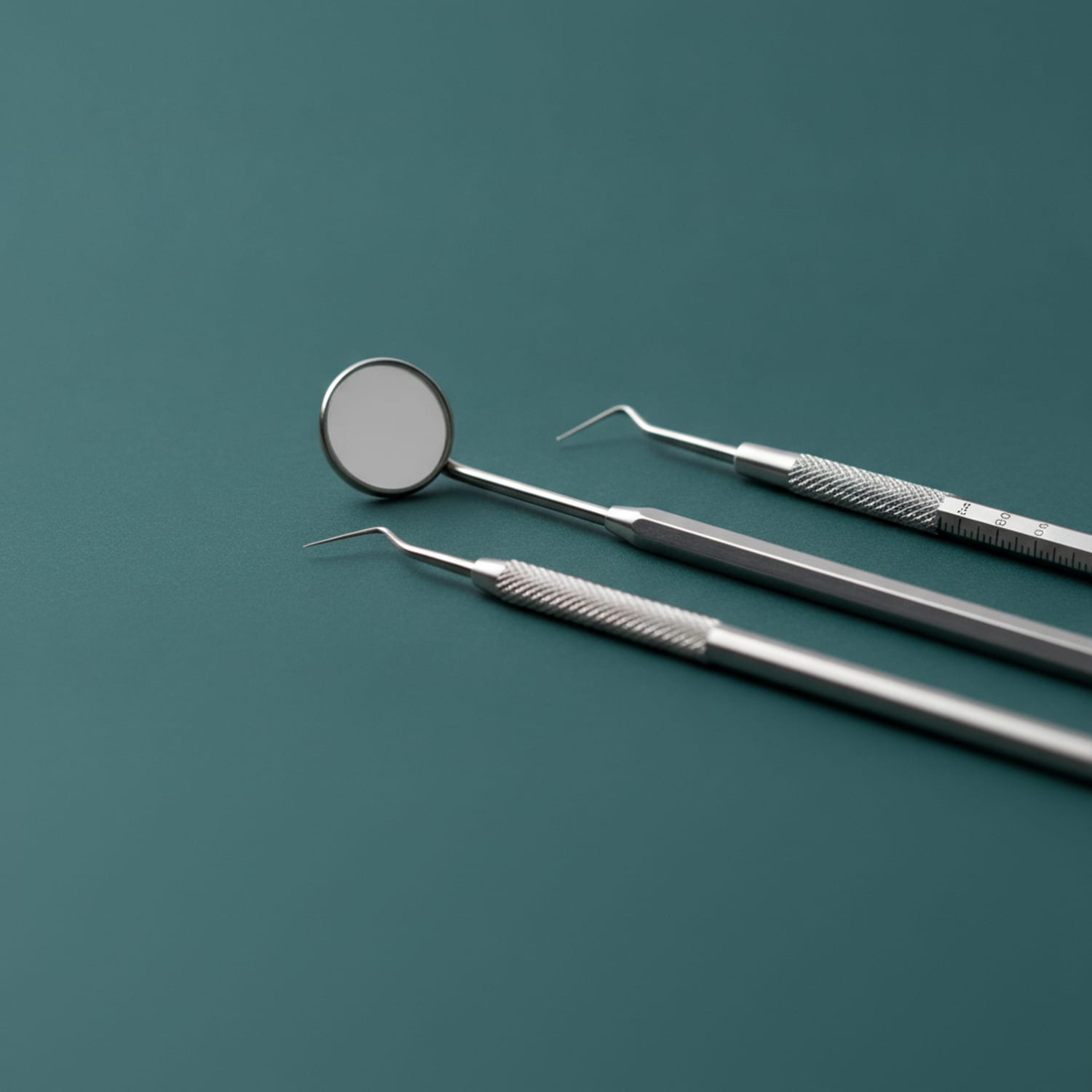
Comprehensive, risk-based preventive dentistry in NYC by Dr. John Shi. A genuine exam — periodontal charting, oral cancer screening, bite and wear evaluation — not just a polish. The cleaning is what you leave with; the exam is the value.

Most "checkups" are a cleaning with a glance.
By the time a tooth hurts, the cheap window has usually closed — a small cavity has become a filling, a filling has become a crown, a crown has become a root canal. Almost none of that is bad luck. It's what happens when the exam is rushed and the recall is set by a calendar instead of your actual mouth. A real preventive visit is designed to catch things while they're still small, quiet, and inexpensive to fix. Here's what that looks like, in plain language.
Problems you can't feel yet
Decay between teeth, a cracked margin on an old filling, early gum inflammation — none of it hurts until it's advanced. Without X-rays and charting, it's invisible.
A cleaning without a real exam
A quick scale-and-polish with a two-second look isn't prevention. The charting, screening, and bite check are the parts that actually protect you — and they're the parts most often skipped.
A recall set by habit, not risk
"See you in six months" is a default, not a diagnosis. Some mouths need three-month intervals; others are fine at twelve. Getting it wrong means either wasted visits or missed problems.
It finds the small thing before it becomes the expensive thing.
Preventive dentistry isn't a single procedure — it's a system for catching disease early. At each comprehensive visit we chart the health of your gums around every tooth, inspect each existing restoration, screen the soft tissue for oral cancer, evaluate your bite and wear, and read your X-rays for decay you can't see. Then we set your next visit by a documented risk score, not a calendar. The result is fewer surprises, smaller treatments, and a mouth that stays yours — not a lifetime of chasing problems after they've already cost you a tooth. Everything is done by Dr. John Shi using the process we call the Centre Method.
Book a comprehensive examUnderstand it fully
What prevention actually involves — and what the evidence shows
At a glance
- 11–51%1
- caries reduction from molar sealants at 24 months
- 43%2
- caries prevented fraction with fluoride varnish
- ~0.43%3
- HbA1c drop from treating gum disease in diabetics
- Risk-based = 6-month4
- recall intervals, equivalent over 4 years (adults)
What actually happens at a comprehensive exam
A genuine preventive visit is far more than a cleaning with a quick look. We chart the periodontal pocket depths around every tooth to detect gum disease before it loosens anything; we examine each existing restoration for margin breakdown where new decay hides; we evaluate the occlusion (your bite) for high spots and wear facets that signal grinding; we palpate the temporomandibular joint for clicking and tenderness; we screen the soft tissue — cheeks, tongue, floor of mouth, palate, and throat — for the colour or texture changes that can suggest oral cancer; and we read your X-rays for interproximal decay between teeth that no visual exam can reach. Each finding is documented so the next visit has a baseline to compare against. The scale-and-polish at the end is the deliverable you feel; the exam is the value you can't.
Risk-based recall — not a fixed calendar
Twice a year is the traditional default, but it isn't a universal prescription. A Cochrane systematic review of primary-care patients found high-certainty evidence that, for adults, a risk-based recall interval produced little to no difference in decayed tooth surfaces, gum bleeding, or oral-health quality of life compared with routine six-month visits over four years. The practical takeaway isn't "come less often" — it's "come as often as your risk warrants." A patient with low decay risk, healthy charting, no bruxism, and few restorations can often safely stretch to nine- or twelve-month intervals. A patient with a periodontal history, gum disease, diabetes, smoking, multiple restorations, or dry-mouth from medication benefits from three- or four-month recalls. We set your interval from a risk score written into your chart, and we revise it whenever your home care or health changes.
Why your gums are a window into the rest of your body
Periodontal (gum) disease isn't confined to the mouth. Chronic inflammation of the tissues supporting your teeth is linked to systemic conditions, and the relationship with diabetes runs in both directions. A Cochrane review found moderate-certainty evidence that treating periodontitis with subgingival instrumentation — professionally removing plaque and calculus below the gumline — reduced HbA1c (a marker of blood-sugar control) by about 0.43% at three to four months in people with diabetes, a clinically meaningful amount. That's why the periodontal charting at every visit matters beyond your teeth: catching and controlling gum inflammation early is one of the cheapest, highest-leverage things preventive dentistry does. If charting reveals active disease, we treat it directly through our gum disease treatment.
Oral cancer screening at every visit
Oral cancer is the most consequential thing a dentist looks for even though it's the rarest thing we find. Survival depends heavily on the stage at which a lesion is caught — small, early lesions are far more treatable than advanced ones, yet many are diagnosed late because they're painless in their early stages. The screening at every comprehensive checkup is a brief visual and palpation exam of the cheeks, tongue (top, sides, and underside), floor of the mouth, palate, throat, and the lymph nodes of the neck. The overwhelming majority of findings are benign — a cheek bite, a harmless white patch, a normal variant — but the discipline of looking carefully every few months is exactly what catches the rare serious ones while they're still small. Anything unusual is documented and either re-evaluated in two weeks or referred for biopsy.
Sealants — a thin barrier where decay starts
Dental sealants are thin resin coatings bonded into the deep pits and fissures on the biting surfaces of molars — the grooves too narrow for a toothbrush bristle to clean, where occlusal decay most often begins. A Cochrane systematic review of permanent molars found moderate-quality evidence that resin-based sealants reduced caries by roughly 11% to 51% at 24 months compared with no sealant, with the benefit sustained through longer follow-up. Sealants are most cost-effective in children whose permanent molars have just erupted, but adults with deep, stain-prone grooves and a history of decay can benefit too. They aren't a substitute for brushing and flossing — they're a targeted barrier for the one spot a brush can't reach. We evaluate suitability tooth by tooth and place them only where the anatomy genuinely warrants it.
Fluoride varnish for higher-risk patients
Fluoride varnish is a professionally applied coating that hardens tooth enamel and reverses the earliest, pre-cavity stages of decay through remineralization. A Cochrane meta-analysis of children and adolescents found moderate-quality evidence that fluoride varnish produced a 43% prevented fraction for decayed, missing, and filled permanent tooth surfaces — meaning caries increment was cut by nearly half in treated groups versus controls. Varnish is most valuable for higher-risk patients: those with active or recent decay, exposed root surfaces, orthodontic appliances, dry mouth, or a diet high in fermentable carbohydrates. Like sealants, it isn't for everyone — we recommend it where the caries risk justifies it and skip it where routine home fluoride is already doing the job.
How preventive care connects to the rest of your dentistry
Prevention doesn't happen in isolation — it's the foundation the rest of your care is built on. The bite and wear evaluation at each visit is often where we first notice grinding, which we manage with a custom night guard before it fractures teeth or restorations. A professional teeth cleaning removes the hardened calculus that home brushing can't. When the exam does turn up early decay, catching it small means a conservative cavity filling rather than a crown or root canal later. And a stable, healthy mouth is what makes elective work — whitening, veneers, or implants — predictable and lasting. Prevention is what keeps the cheap, easy interventions from ever becoming the expensive, complicated ones.
Related at Centre Dental
Concerned about comfort, bone, or cost?
These are the questions a consultation answers directly. Dr. Shi reviews your 3D CBCT scan, evaluates your bone and candidacy, and outlines your options, treatment timeline, and estimated cost — including what your insurance may cover.
Thinking about it
The questions we hear first
How often should I really have a checkup?
Every six months is the traditional default for healthy patients, but it's a starting point, not a rule. A Cochrane review found that for adults, a risk-based interval performs as well as fixed six-month visits over four years — so the right answer depends on your mouth. Three or four months is more appropriate if you have a periodontal history, diabetes, smoke, or carry extensive restorations. Nine to twelve months can be perfectly safe if your charting stays healthy, your decay risk is low, and you have few restorations. We set your recall from a documented risk score and revise it as your situation changes, rather than defaulting everyone to the same calendar.
What's actually included in a comprehensive exam?
Periodontal charting around every tooth, a check of each existing restoration for breakdown, an oral cancer screening of the soft tissue and neck lymph nodes, a bite and wear evaluation, a TMJ check, and a review of your X-rays for decay between teeth. Every finding is documented so we have a baseline to compare against next time. The cleaning happens at the end — it's the part you feel, but the exam is the part that protects you. If we find something, you see the X-ray or the clinical finding before anything is recommended.
How much does a preventive visit cost, and does insurance cover it?
A comprehensive new-patient exam with X-rays and cleaning costs more than a routine recall for an existing patient, and add-ons like sealants are priced per tooth — you'll get a written estimate before anything beyond a basic exam. Most PPO plans cover two preventive exams and cleanings per year, typically at a high percentage with no deductible, plus X-rays on a periodicity schedule and sealants for children (increasingly for adults too). Centre Dental is non-participating with most PPO plans, which means you pay us directly and submit for out-of-network reimbursement. We'll help you read your benefits so there are no surprises.
How often do I actually need X-rays?
Following American Dental Association guidance, bitewing X-rays are typically taken every six to eighteen months for adults based on decay risk, with a full-mouth series or panoramic image every three to five years. We adjust to your individual risk — a patient with no recent decay and stable restorations gets fewer images than one with active issues. Modern digital sensors use a fraction of the radiation of old film. We never take X-rays for billing reasons; each one is taken because it answers a specific clinical question.
Why is oral cancer screening part of a routine checkup?
Because survival depends heavily on how early a lesion is found, and early oral cancers are usually painless — which means they're easy to miss without a deliberate look. The screening is a quick visual and palpation exam of your cheeks, tongue, floor of mouth, palate, throat, and neck lymph nodes at every comprehensive visit. The vast majority of what we find is completely benign, but the point is the consistency: examining carefully every few months is what catches the rare serious lesion while it's still small and treatable. Anything unusual is documented and re-checked in two weeks or referred for biopsy.
Are dental sealants worth it — and can adults get them?
For the right teeth, yes. A Cochrane review of permanent molars found resin-based sealants reduced decay by roughly 11% to 51% at 24 months versus no sealant. They're most cost-effective in children whose molars have just come in, but adults with deep, decay-prone grooves and a cavity history benefit too. A sealant is a targeted barrier for the one spot a toothbrush physically can't clean — it isn't a replacement for good home care. We evaluate each tooth individually and place sealants only where the groove anatomy and your risk genuinely justify it.
Can preventive care really affect my overall health?
Your gums are more connected to the rest of your body than most people realize. Chronic gum inflammation is linked to systemic conditions, and with diabetes the relationship goes both ways — a Cochrane review found that treating periodontitis lowered HbA1c (a blood-sugar marker) by about 0.43% at three to four months, a clinically meaningful improvement. That's why the periodontal charting at every visit matters beyond your teeth: catching and controlling gum disease early is one of the highest-leverage things preventive dentistry does. If your bite check reveals grinding, a night guard protects your teeth from a different kind of long-term damage.
What happens if you find a problem at my checkup?
You see the evidence first. We show you the X-ray or the clinical finding, explain what it is, and lay out the options — including watch-and-monitor when that's genuinely the right call — along with what each option costs and the risk of waiting. The plan is written down, the decision is yours, and nothing is treated at the same appointment unless you specifically ask us to. Catching a problem early usually means the fix is small: an early cavity becomes a conservative filling rather than the crown or root canal it would have become if left alone.
The path
Your journey, start to finish
Comprehensive exam + records
Your first visit is a full workup: periodontal charting, restoration check, oral cancer screening, bite and TMJ evaluation, and the X-rays your risk level calls for. Everything is documented so we have a baseline. You'll also get a clear cost and insurance estimate for anything beyond the basic exam.
Your written risk assessment
We translate the exam into a documented risk score — for decay, gum disease, and wear — and use it to set a recall interval calibrated to your actual mouth, not a calendar default. You leave knowing exactly why your interval is what it is.
Cleaning + targeted prevention
A professional cleaning removes the hardened calculus home care can't. Where indicated, we add sealants on decay-prone grooves or fluoride varnish for higher-risk teeth — placed selectively, never across the board.
Recall on your schedule, revised as you change
You return at the interval your risk warrants — three, six, nine, or twelve months. Each visit re-scores your risk against the last baseline, so the plan adapts as your home care and health evolve. Prevention is a moving target, and we keep aiming at it.
Explore Further
Related Services
Professional Teeth Cleaning
The hygiene visit that removes hardened calculus home brushing can't reach.
Learn moreGum Disease Treatment
Deep cleaning and periodontal therapy when charting reveals active inflammation.
Learn moreCavity Fillings
Conservative, tooth-coloured restorations for the early decay a real exam catches.
Learn moreMeet Dr. John Shi, DDS
Columbia-trained, with the exam discipline that makes prevention genuine.
Learn morePreventive Dentistry Near You in NYC
Start here
Schedule your consultation
In a single visit, Dr. Shi reviews your 3D scan, assesses your candidacy for preventive dentistry, and provides a written treatment plan with cost and insurance details — so you can decide with all the facts.
Extensive full-arch reconstruction experience by Dr. Shi
3D-guided precision, placed by an experienced surgeon
Bilingual — English, Mandarin, Cantonese
Live clinic hours · 139 Centre St, Lower Manhattan, NYC

