
One appointment. No temporary crown. Porcelain crown placed the same day.
Same Day Crowns NYC — CEREC Porcelain Crown in One Visit
Same day crowns in NYC at Centre Dental use CEREC digital scanning and in-house milling to design, mill, and cement a permanent porcelain crown in a single two-hour visit — no temp...
DDS
Columbia University 1998
22+
Years on Centre St
5.0
150+ Google reviews
Overview
Same-Day Crowns (CEREC)
Same day crowns in NYC at Centre Dental use CEREC digital scanning and in-house milling to design, mill, and cement a permanent porcelain crown in a single two-hour visit — no temporary restoration, no second appointment, no gooey impression material.
- Single-visit crown — complete in one appointment
- No temporary crown required
- 3D digital impression (no gooey impression material)
- Porcelain color-matched to surrounding teeth
- In-house CEREC milling unit on site
- Same-day result — leave with a finished crown
- Precise digital fit verified before cementation
- Bilingual care in English and Mandarin
“When I'm choosing between emax and zirconia for a CEREC crown, the first question is where the tooth sits and what forces it takes. Emax gives us the most natural light transmission for a front tooth — 500 MPa flexural strength, beautiful aesthetics. Zirconia at 1,000 MPa is the right call for a molar, especially in a patient who grinds. The material matters as much as the same-day convenience.”
How It Works
The Process
What Is CEREC Technology — and What the Research Actually Shows
CEREC (Chairside Economical Restoration of Esthetic Ceramics) is a digital workflow that allows a dentist to design and mill a ceramic crown entirely within the office during a single appointment. An intraoral 3D scanner replaces the traditional impression tray, and design software shapes the crown geometry to match your bite and adjacent teeth. The milled block — emax ceramic or zirconia — is fired, polished, and cemented the same day. The convenience is real, but so is a nuance worth knowing: a 2019 Journal of Prosthodontic Research meta-analysis (PMID 31303569) found CAD/CAM crowns carry a 1.84× higher failure risk than lab-fabricated crowns in pooled data. That number reflects heterogeneous technique across many practices — experienced operators who have completed the learning curve achieve outcomes that are clinically comparable. The 10-year survival data from an independent Glidewell study puts BruxZir zirconia at 100% and emax at 94%. Same-day crowns are not categorically inferior, but operator experience matters, and any practice offering them should be transparent about that.
Choosing the Right Material — Emax vs Zirconia by Tooth Position
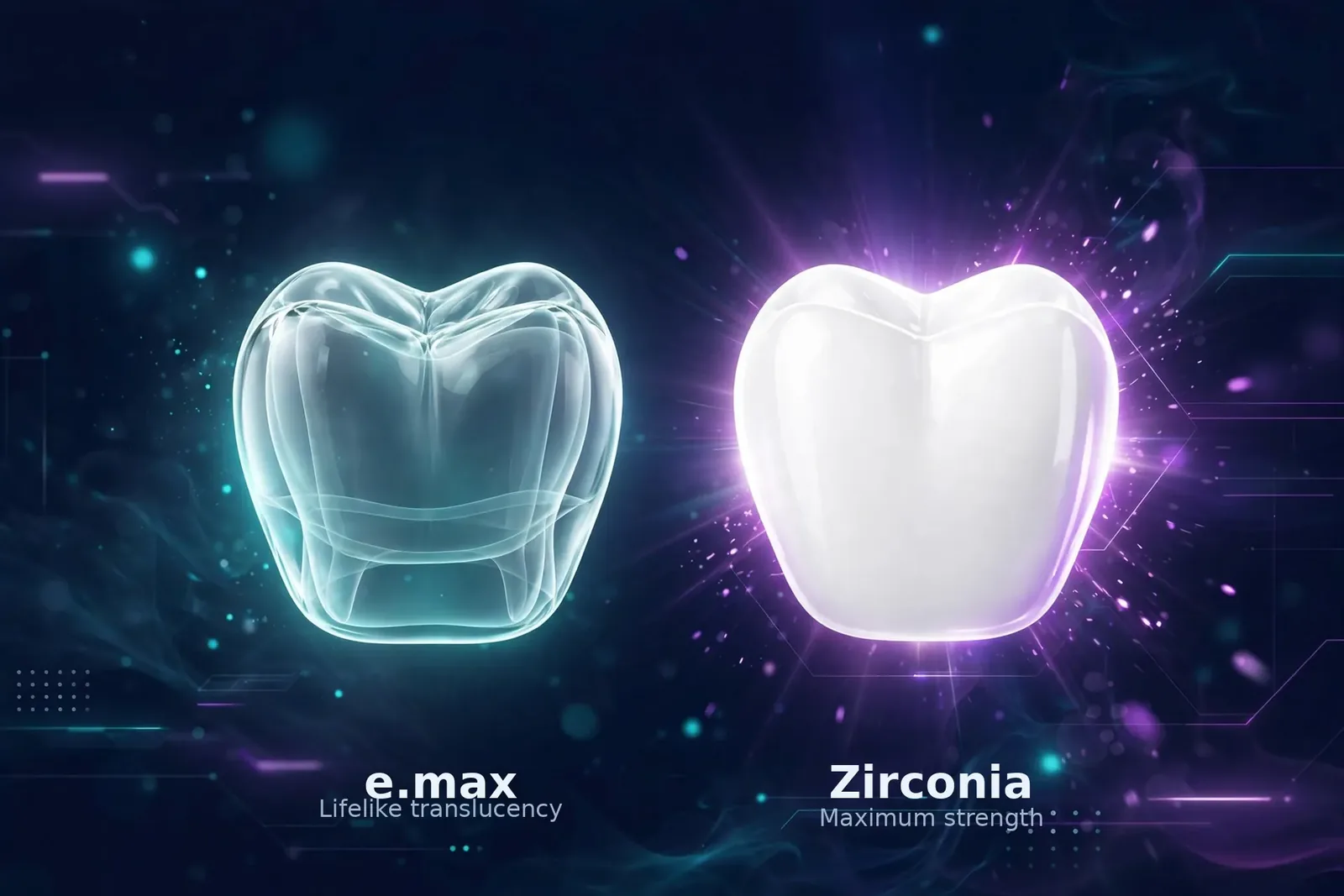
Not all CEREC crowns are milled from the same block. Material selection is the single most consequential decision in a same-day restoration, and it should be driven by where the tooth sits in the mouth and the forces it absorbs. Emax lithium disilicate has a flexural strength of approximately 500 MPa and light-transmission properties that closely mimic natural enamel — the right choice for anterior and premolar positions where aesthetics are the priority. Full-contour zirconia reaches 1,000 MPa — roughly twice the strength — which makes it the preferred material for posterior molars under heavy occlusal load, or for patients with bruxism. A flat-looking crown is one of the most common patient complaints about same-day restorations; it almost always comes down to material selection and contour design, not the CEREC technology itself. Marginal fit between chairside CAD/CAM and lab crowns is now comparable — a 2020 study (PMC7730557) measured CEREC marginal gaps at 115µm versus 108µm for lab restorations, a clinically insignificant difference. The right material, well-designed, performs predictably for a decade or more.
When CEREC Is and Is Not the Right Choice
Same-day CEREC crowns suit most single-unit restorations: large decay, cracked teeth, post-root-canal coverage, and failing large restorations where insufficient healthy enamel remains. The technology is well-validated for these indications. Cases that remain better served by a dental laboratory include complex multi-unit bridges requiring precise interarch coordination, implant-level restorations where prosthetic components add design complexity, and severely broken-down teeth where occlusal planning benefits from a laboratory technician's direct involvement. Patients who grind heavily are good CEREC candidates specifically when zirconia is selected — not when emax is used in a high-stress posterior position. Before treatment begins, your dentist will review radiographs and photograph the tooth to confirm candidacy and confirm which material is appropriate for your anatomy.
Clinical Evidence
A 10-year independent study on BruxZir zirconia crowns reported 100% survival; emax ceramic reached 94% — both fabricated chairside via CAD/CAM (Glidewell, 2023).
Timeline
Single visit, typically under 2 hours
Typical treatment duration
Why a same-day crown changes the patient experience
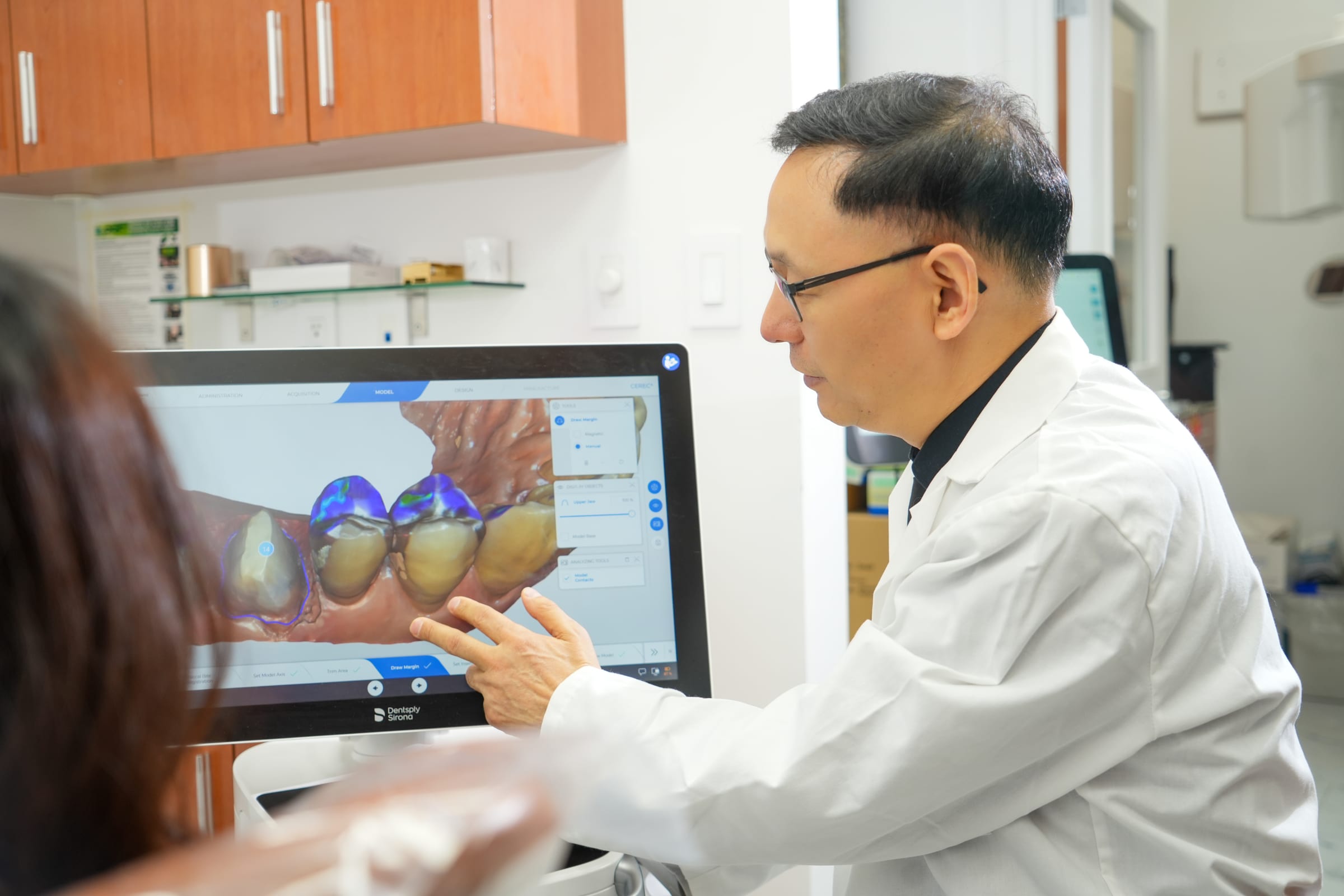
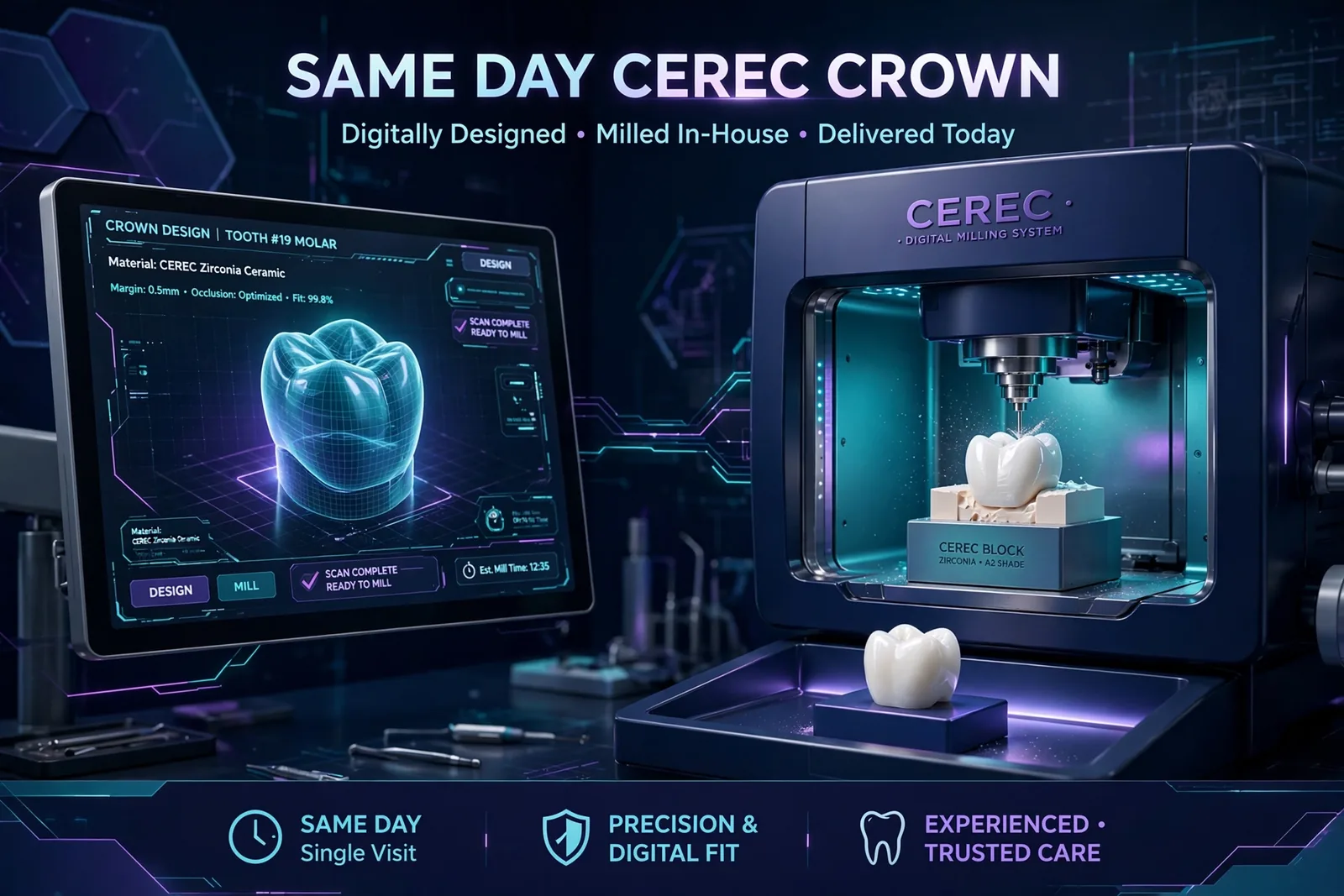
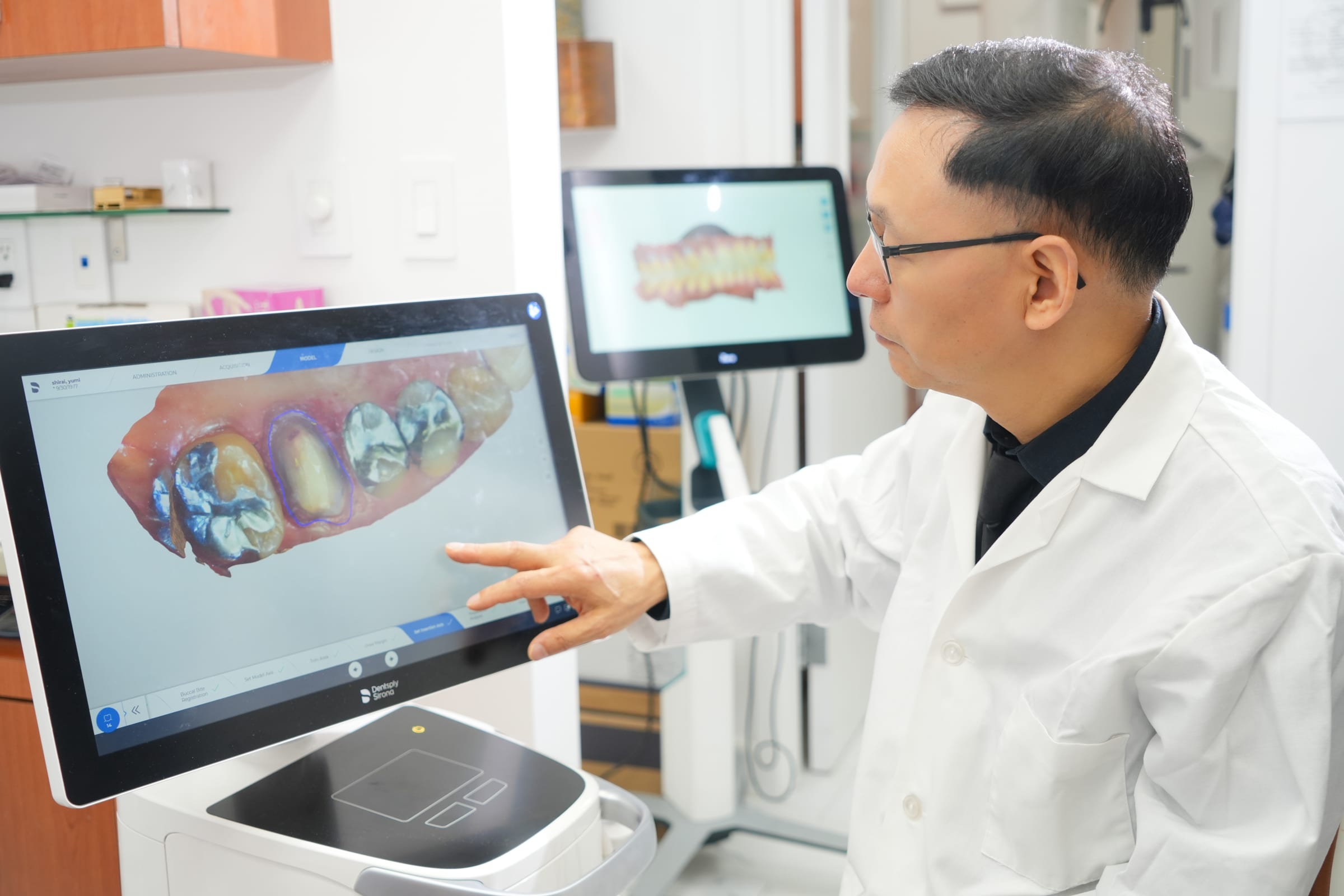
A traditional crown takes two appointments separated by two-to-three weeks: prep + impression + temporary crown at visit one, then cement the lab-fabricated permanent at visit two. Centre Dental compresses that into a single visit using a CEREC Primemill milling unit paired with a 3Shape TRIOS intraoral scanner. The TRIOS scanner captures the prepared tooth, the design software builds the crown digitally in roughly fifteen minutes, the Primemill cuts the porcelain block, and the crown is bonded the same day.
Same-day delivery removes the temporary-crown phase entirely — no risk of the temp coming loose, no chewing restrictions during the wait, and no second-injection appointment.
Adjusting contacts, occlusion, and emergence in software
Inside the design software the crown begins as a starting proposal generated from the scanner data and the patient’s existing bite. Dr. Shi adjusts contact points, occlusal anatomy, and emergence profile against the opposing arch — the same parameters a master ceramist would refine by hand at a traditional lab, executed in software with millimeter precision.
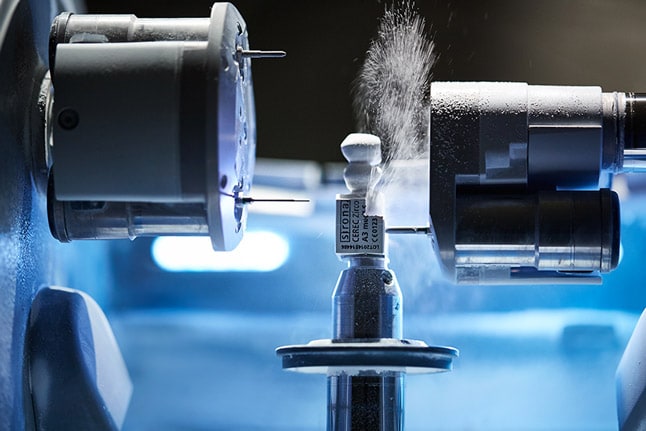
The chosen ceramic block — typically lithium disilicate (Emax) for anterior aesthetics or zirconia for posterior strength — is loaded into the Primemill unit. Milling takes roughly fifteen minutes for a single-tooth crown. After milling, the crown is fired in a sintering oven for full strength, polished, and bonded the same visit. The two-week lab-turnaround gap of traditional crowns disappears entirely.
Inside Our Practice
See it in action
Common Questions
Frequently Asked Questions
What is a CEREC crown?
CEREC is a chairside digital system that allows a dentist to design and mill a ceramic dental crown during a single office visit. A 3D intraoral scanner replaces traditional impression material, and an in-office milling unit fabricates the crown from a solid ceramic block — either emax lithium disilicate or zirconia, depending on the tooth position and patient factors. The finished restoration is cemented the same day, with no external laboratory involved and no temporary crown required. The convenience is genuine, but outcomes depend heavily on the clinician's experience with the system and the appropriateness of material selection for your specific tooth.
How long does a CEREC appointment take?
Most same-day crown appointments run 90 to 120 minutes from preparation through cementation. The milling itself takes approximately 15 minutes. The remainder of the time covers tooth preparation under local anesthesia, digital scanning, chairside design review, glazing, and fit verification. Patients do not need to return for a second delivery appointment. If design refinements are needed after milling — to improve contour or bite contact — those are addressed chairside before the crown is cemented.
How do CEREC crowns compare to lab-fabricated crowns?
The honest answer is: comparable in the hands of an experienced operator, with real nuance in the data. A 2019 Journal of Prosthodontic Research meta-analysis found CAD/CAM crowns carry a 1.84× higher failure risk in pooled data — a number that reflects wide variation in operator technique across many practices. Marginal fit, often cited as a concern, is now statistically comparable: a 2020 study measured CEREC margins at 115µm versus 108µm for lab crowns — a clinically insignificant difference. Long-term survival data on zirconia runs at 100% and emax at 94% at 10 years. The primary practical advantage of CEREC is time: no temporary crown, no second appointment.
Emax or zirconia — which material is right for my crown?
Material selection is the most consequential decision in a same-day crown, and it should be driven by tooth position and bite load, not convenience. Emax lithium disilicate has a flexural strength of approximately 500 MPa and the best aesthetic light transmission — ideal for front teeth and premolars where appearance matters. Zirconia reaches roughly 1,000 MPa in strength, making it the right call for posterior molars under heavy occlusal forces or for patients who grind their teeth. Placing emax on a high-stress molar or choosing material based purely on availability is a common source of early failures. Your dentist will confirm the appropriate material before preparation begins.
Is same-day CEREC cheaper than a lab crown?
Not necessarily. Same-day CEREC crowns and lab-fabricated crowns are comparable in cost, with the price driven primarily by tooth location and clinical complexity rather than fabrication method. What you save with CEREC is time — one appointment instead of two, and no temporary crown to manage in between. Most dental insurance plans that cover crowns reimburse CEREC and lab crowns at the same benefit level. Our team provides a written estimate before treatment begins.
Does insurance cover CEREC crowns?
Most dental insurance plans that include major restorative coverage treat CEREC crowns the same as conventionally fabricated crowns — the fabrication method is typically not a coverage distinction. Coverage usually applies at 50% of the allowed fee after the deductible, subject to your annual maximum. We verify your benefits before your appointment so you have a clear picture of your out-of-pocket cost before any preparation begins.
How long does a CEREC crown last?
With appropriate material selection and proper care, a CEREC crown is expected to last 10 to 15 years or more. Independent 10-year data puts zirconia at 100% survival and emax at 94% — results that are comparable to the best lab-fabricated crowns. Longevity is most affected by bite load, grinding habits, and gum health at the margin. Crown longevity is not determined by whether it was milled chairside or in a lab; it is determined by material choice, fit quality, and how well the patient maintains the gum line around the crown.
Can I get a CEREC crown if I grind my teeth?
Yes, with the right material. Patients with bruxism should receive zirconia crowns specifically — not emax — when posterior teeth are involved. Zirconia's 1,000 MPa flexural strength is far more resistant to the cyclic loading of nighttime grinding than emax at 500 MPa. Beyond material selection, the treatment plan should address the grinding itself. An unmanaged bruxism habit significantly increases the long-term failure risk of any crown regardless of material. A custom night guard is typically recommended to protect the restoration and the opposing dentition.
Why do some same-day crowns look flat or unnatural?
Flat-looking crowns without natural depth or contour are one of the most common patient complaints about same-day restorations, and they are almost always a design and material issue rather than a CEREC technology issue. Monolithic zirconia milled without adequate characterization can appear opaque. Emax, when glazed skillfully, produces results that are visually indistinguishable from natural enamel. The chairside design step — where the dentist adjusts contour, cusp anatomy, and shade matching — is where those distinctions are made. At Centre Dental, every crown goes through a detailed fit and appearance review before cementation.
What aftercare is needed following a CEREC crown?
For the first 24 hours, avoid very hard or sticky foods while the cement reaches full strength. After that, normal eating resumes. Continue brushing twice daily and flossing daily — including along the crown margin, where plaque accumulation drives decay at the gum line. A Waterpik or interdental brush is particularly useful for cleaning the gingival margin. Return for professional cleanings every six months so your dentist can assess margin integrity, gum health around the crown, and bite equilibration over time.
Explore Further
Related Services
Same-Day Crowns (CEREC) Near You in NYC
Start Here
Your Smile Starts With a Conversation
Begin with a no-obligation consultation about same-day crowns (cerec). Dr. Shi reviews your 3D scan, walks through your options, and provides an honest investment range — no pressure, no obligation.
Extensive full-arch reconstruction experience by Dr. Shi
3D-guided implant precision, placed by an experienced surgeon
Bilingual care — English, Mandarin, Cantonese
Open Mon–Sat · 139 Centre St, Lower Manhattan, NYC